Shri Ajeet Singh
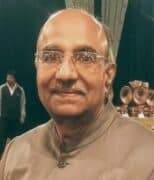
(We present an article ‘Morse Code of News…’ written by Shri Ajeet Singh ji, Ex-Director (News), Door Darshan.)
☆ Morse Code of News… ☆ Shri Ajeet Singh ☆
(Tomorrow we will present Hindi version of this article.)
Somehow, I got my hands on the Morse codes of basic learning at schools and colleges and cleared the UPSC examination of the junior grade of the Indian Information Service. I arrived in Shimla on June 15, 1971, to learn the Morse code of news and broadcasting at my first job in the Monitoring Service of All India Radio.
On the very first day, I was quite puzzled that the term “stories” was being used for news. To me, stories were imaginative tales of dogs, cats, monkeys, bears, and lions—like the ones in the Panchatantra. How could accounts of people arguing, fighting, or discussing things be considered “stories”?
I didn’t dare ask anyone, fearing they might think I was a dumb person. I simply accepted it. Now, 54 years later, after reflecting, I feel there really isn’t much difference between stories of animals and those of humans. Especially after watching the prime-time debates on TV news channels—there’s hardly any difference.
Recently, I saw a viral joke on WhatsApp.
A man from the neighborhood asks a girl: “What job do you do?”
She replies, “I organize dog fights.”
The man, surprised, says, “What kind of job is that?”
She replies, “I’m a news anchor.”
Indeed, news has become synonymous with conflict. If everything is peaceful and cheerful, it’s not considered news. But if there’s a fight, abuse, violence, or destruction—the bigger the chaos, the bigger the news.
This obsession with news has replaced our grandmothers’ and mothers’ bedtime stories.
To understand news today, one must understand the ingredients that go into making it—fear, sensation, spying, drugs, sex, and whatnot. This is the Morse Code of news.
Thankfully, we were spared from having to learn all of it. Back then, All India Radio still believed in clean and truthful reporting. It still does today, but audiences have moved to private channels. The signal coverage may be 100%, but how many still tune in?
Mass media gets you addicted and then drains your pockets without you even noticing. Now even our minds are being stolen.
The Morse Code of social media these days is complex and twisted. Every citizen must be smarter than their smartphone. That’s what Professor Archana Singh from Panjab University, Chandigarh said in our recent webinar.
⸻
I’m talking about a bygone era when news was sent via telegram, using Morse code.
At the risk of sounding self-praising, I must say—when I became a correspondent in the 1970s, rightly or wrongly, I felt it was the best job in All India Radio.
I interacted with prominent people, traveled across India and abroad, attended press conferences, interviews, had STD phones at home and office, bylines in national bulletins… no fixed office timings! File a story and head off—to the Press Club or anywhere else to relax, eat, or chat.
What more could one want?
Gradually, though, press notes and press conferences began to feel routine and boring. I started enjoying literary gatherings and cultural events. Literature began influencing my journalism. A certain refinement emerged in my writing. I adopted the literary style, though I never had to rely on imagination. As they say, “sometimes facts are stranger than fiction.”
In the field, I often encountered such facts—so vivid they seemed fictional. What I wrote weren’t stories, but reports.
At literary events, journalists were rarely present. They didn’t see any “news potential” there. But the grip that writers and poets had over words—that was something journalism often lacked. I started developing a taste for literature.
Journalism is often called hurried literature. But literature cannot be written in haste. It requires patience. Journalism is a race—who can break the news first. This race can make journalists frantic. Some even mess up reports or exaggerate them to ensure they get published, so news agencies don’t beat them, and they don’t face their editor’s wrath the next day.
In those days, All India Radio was the first to break news. That meant I had to stay extra alert. I realized over time that just collecting facts isn’t enough.
You have to write them in the traditional 5 Ws and 1 H format—or give it a personal touch as a voice cast. News management was essential too. One story had to be prepared in six different time zones—Early Morning, Late Morning, Early Midday, Late Midday, Early Evening, Late Evening. We had to find multiple angles for the same story—Voice Casts, Newsreels, Current Affairs, Spotlights, Morning Commentaries, Reviews.
Writing the intro—or the lead of a news story—is no easy task. Journalists suffer from “mental constipation” over it. They write, cut, and rewrite. Once the lead is ready, the rest becomes easier.
Understanding the Morse code of news takes time.
Reporting is also the process of writing contemporary history. A reporter is a witness to historical events.
⸻
My field posting was in the state of Jammu & Kashmir—13 years in Jammu and around 6.5 years in Srinagar. I worked in difficult conditions. All in all, it turned out well. I was awarded Correspondent of the Year award by All India Radio and also received a Certificate of Merit.
The Newsroom of the News Services Division in Delhi is a peculiar place. Your service seniority doesn’t matter—only professional competence does. Senior officers might handle small bulletins while juniors might be Editors-in-Charge. The place is filled with brilliant people. Even a stenographer might shout at the News Editor saying, “Sir, there’s no ‘the’ before Parliament.” And if you ask why, you might hear, “Because it doesn’t work in English, sir.”
People used to dread attending DG Harish Awasthi’s news meetings. But he was a remarkable professional. Like school kids, we learned the art of news from him. Some got scolded harshly. Amid all this, the Morse code of news started becoming clearer.
⸻
After retirement, I wondered what to do. No more press notes, no more press conferences—who or what would I report on?
I challenged myself—to report on the common man.
The person whose name, work, struggle, and achievements rarely make the news.
We started a small organization with 8–10 friends, called Vanaprasth Senior Citizen Club. We began organizing detailed self-introduction sessions of each member. I began writing engaging news features and sending them to local newspapers.
This continues even after 18 years. The organization now has nearly 140 members.
Strange thoughts come to mind. Moving memories well up in the heart. They compel me to write.
Articles like:
- The House of Makhanlal Bekas..
- The Punjabi Daughters of Harsinghpura: Why They Always Mention Their Village
- In Memory of Chatrapal
- The CRPF Girls in Srinagar
- A Radio Announcer’s Railway Station
- An Entire Family Born on August 15
- Jingoism: On the Rise or on the Wane?
- Pandit Jasraj Came to PilI Mandori Looking for Jasia
- Remembering Father During Pitri Paksha
- Sumitra Had Said…
Writing about your father or wife is both easy and hard. Who knows them better than you? But making such personal stories interesting for readers is difficult. There’s the issue of privacy too.
Sometimes I feel there’s a fundamental flaw in the evolution of human civilization—that we see news in bloodshed, conflict, death, and destruction, and sensationally promote it. But we fail to see news in laughing children, blooming flowers, and celebrating communities.
The kind of information circulated shapes the kind of society we become.
These days, everyone debates like TV anchors—full of rage and agitation.
Good news seems to have vanished.
I search for good news.
I believe every person has remarkable stories. If asked properly, they’re willing to share. That’s what I try to do within my limited capacity.
⸻
For the past six years, I’ve been connected to several groups of talented people who give me immense love, encouragement, and inspiration.
The Morse code of news now seems to be gradually turning into the Morse code of writing.
The telegram system using Morse code is now extinct. New technologies have emerged. Writing styles are adapting to them. You can now speak in any script and get it typed on your phone and send it instantly.
My writing style has adapted accordingly. Some friends say—though my writing is about journalism, its style feels literary.
I want to hear your stories.
And I want to share mine.
The Morse code of news is fascinating, not dull.
It’s difficult, but also deeply enjoyable.
I tried to understand it and shape it my way.
⸻
Thank you, friend Vijay Dixit, the Deputy Director General of All India Radio (Retired) for giving me this new phrase: ‘The Morse Code of News.’
⸻
© Shri Ajeet Singh
Shri Ajeet Singh ji is a freelance journalist based at Hisar. He retired as Director of News, Door Darshan Hisar in 2006.
Mo. – 9466647037
≈ Blog Editor – Shri Hemant Bawankar/Editor (English) – Captain Pravin Raghuvanshi, NM ≈


