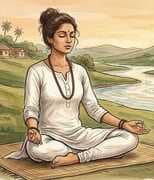
(Radhika Bisht is a yoga teacher in the tradition of Swami Satyananda Saraswati. Trained at the Parmarth School of Yoga, Rishikesh and Himalayan Iyengar Yoga Centre, Dharamshala. She has an experience of 20 years in conducting yoga sessions.)
🌌 Yoga: The Inner Science of Life 🌌 Radhika Bisht 🌌

☆ From Vedic Wisdom to Patanjali’s Path of Self-Realisation ☆
Yoga is often reduced to postures and breathing techniques in popular understanding, but its true scope is far wider, deeper and infinitely more transformative. It is not merely an exercise system; it is a philosophy of life, a science of consciousness, and a timeless path leading human beings from restlessness to stillness, from fragmentation to wholeness.
To understand yoga is to enter a vast stream of wisdom flowing through the Vedas, the Upanishads, the philosophical systems of India, and the teachings of realised sages.
Let us journey through some of its essential foundations.
What Does Yoga Truly Mean?
Yoga is one of those rare words whose meaning expands the more deeply one lives it. To me, yoga is not simply a practice; it is a way of life.
It can be understood in many ways:
– Yoga is the path of selfless action (Karma Yoga), where work becomes worship.
– Yoga is the path of devotion (Bhakti Yoga), where love becomes the bridge to the Divine.
– Yoga is the path of knowledge (Jnana Yoga), where enquiry burns ignorance.
– Yoga is the science of right living, harmonising body, mind and spirit.
– Yoga is the art of self-mastery—controlling the body, senses, mind and intellect.
– Yoga is union: the coming together of the individual self with the universal Self.
The classical definition given by Patanjali remains one of the most profound:
“Yogascittavrttinirodhah”
Yoga is the cessation of the fluctuations of the mind.
This simple yet powerful sutra reminds us that the mind, when stilled, becomes a mirror reflecting truth.
The Vedic Roots of Yogic Wisdom
The roots of yoga lie deep in the sacred Vedic tradition. The four Vedas form the foundation of Indian spiritual knowledge:
– Rig Veda
– Sama Veda
– Yajur Veda
– Atharva Veda
Vedic knowledge is further divided into four sections:
Samhitas — collections of hymns
Brahmanas — ritualistic explanations
Aranyakas — contemplative forest teachings
Upanishads — philosophical revelations
The Upanishads, in particular, are the soul of Indian spirituality. They take us beyond ritual into direct enquiry: Who am I? What is the nature of reality?
Aum and the Three States of Consciousness
Among all sacred sounds, Aum (Om) is considered the primordial vibration of existence. It contains within itself the entire spectrum of consciousness.
Its three matras—A, U, and M—symbolise:
– Jagrata (waking state)
– Svapna (dream state)
– Sushupti (deep sleep state)
Beyond these three lies the silent fourth—Turiya, the transcendental state—pure awareness beyond all mental activity.
Thus, Aum is not merely a sound; it is a map of consciousness.
The Mahavakyas: Great Truths of the Upanishads
The Upanishads distil their highest wisdom into four great declarations known as the Mahavakyas:
– Prajnanam Brahma — Consciousness is Brahman
– Ayam Atma Brahma — This Self is Brahman
– Aham Brahmasmi — I am Brahman
– Tat Tvam Asi — Thou art That
These are not intellectual statements but invitations to awaken to one’s true nature.
The Six Classical Philosophical Systems
Indian philosophy developed through six major orthodox systems (Shad Darshanas):
– Nyaya — Nyaya Sutra by Gautama
– Vaisheshika — Vaisheshika Sutra by Kanada
– Samkhya — founded by Kapila; systematised in Samkhya Karika by Ishvarakrishna
– Yoga — Yoga Sutras by Patanjali
– Purva Mimamsa — Mimamsa Sutras by Jaimini
– Vedanta — Brahma Sutras by Badarayana
Together, they offer a complete framework for understanding reality.
Alongside these arose non-Vedic systems like Buddhism, Jainism and Charvaka, each contributing its own vision of truth.
Samkhya: Understanding Creation
Samkhya philosophy forms the metaphysical backbone of yoga. It begins with three fundamental principles:
– Purusha — pure consciousness
– Prakriti — primordial nature
– Buddhi (Mahat) — cosmic intelligence
The entire manifest universe evolves from the interplay of Purusha and Prakriti. Yoga helps us disentangle consciousness from matter and return to our essential freedom.
The Five Koshas: Layers of Human Existence
The human being is not merely a physical body. According to Vedanta, we exist through five sheaths (Koshas):
– Annamaya Kosha — the physical body
– Pranamaya Kosha — the energy body
– Manomaya Kosha — the mental body
– Vijnanamaya Kosha — the wisdom body
– Anandamaya Kosha — the bliss body
Yoga gradually purifies these layers, leading us inward from gross to subtle.
The Vedantic Path of Sadhana
Vedanta emphasises Jnana Yoga, the path of wisdom. This unfolds in three stages:
Shravana — listening to the truth
Manana — reflecting upon it
Nididhyasana — deep meditation on it
This progression transforms borrowed knowledge into lived realisation.
Hatha Yoga: Preparing the Body for Higher Consciousness
Before the mind can become still, the body and prana must be balanced. This is the domain of Hatha Yoga.
Its three foundational texts are:
– Hatha Yoga Pradipika by Svatmarama
– Gheranda Samhita
– Shiva Samhita
These texts offer practical methods to purify the body and awaken latent energy.
Vrittis: The Waves of the Mind
In Patanjali’s psychology, vrittis are the modifications of the mind. They are five:
– Pramana (right knowledge)
– Viparyaya (wrong knowledge)
– Vikalpa (imagination)
– Nidra (sleep)
– Smriti (memory)
These vrittis constantly shape our experience of reality. Yoga seeks not to suppress them violently, but to understand and transcend them.
Chitta Bhoomi: The Five Mental States
The mind moves through five stages:
– Kshipta — restless
– Mudha — dull
– Vikshipta — distracted
– Ekagra — one-pointed
– Nirodha — fully restrained
Most human suffering belongs to the first three states. Yoga leads us toward Ekagra and ultimately Nirodha, where true meditation becomes possible.
The Eightfold Path of Patanjali
The practical roadmap of yoga is the Ashtanga Yoga:
- Yama (ethical restraints)
- Niyama (personal observances)
- Asana (posture)
- Pranayama (breath regulation)
- Pratyahara (withdrawal of senses)
- Dharana (concentration)
- Dhyana (meditation)
- Samadhi (absorption)
This is not merely a sequence of practices but a progressive refinement of human consciousness.
The Two Dimensions of Samadhi
The culmination of yoga is Samadhi, the state of complete absorption.
There are two broad types:
Savikalpa Samadhi — where awareness of the object of meditation remains. There is still a subtle duality.
Nirvikalpa Samadhi — where all distinctions disappear. There is no observer and no observed; only pure, indivisible awareness remains.
This is the summit of yogic experience—the homecoming of consciousness to itself.
Yoga: A Journey Inward
At its heart, yoga is a return—a return to silence, to clarity, to our original nature. The ancient sages did not create yoga as a system of escape from life, but as a way to live it more deeply, consciously and truthfully.
In a world of constant distraction, yoga remains a timeless invitation: to know oneself, to master the mind, and to discover the still centre within.
For when the mind becomes quiet, the soul begins to speak.
♥ ♥ ♥ ♥
© Radhika Bisht
Yoga Teacher
≈ Editor – Shri Hemant Bawankar/Editor (English) – Captain Pravin Raghuvanshi, NM


Nice edition here:
https://www.yogavidya.com/shiva-samhita.html