English Literature – Articles ☆ 🎶 USTAD HARJINDER PAL SINGH MATHARU ☆ Shri Jagat Singh Bisht ☆


Shri Jagat Singh Bisht

(Master Teacher: Happiness & Well-Being, Laughter Yoga Master Trainer, Author, Blogger, Educator, and Speaker.)

Authored six books on happiness: Cultivating Happiness, Nirvana – The Highest Happiness, Meditate Like the Buddha, Mission Happiness, A Flourishing Life, and The Little Book of Happiness. He served in a bank for thirty-five years and has been propagating happiness and well-being among people for the past twenty years. He is on a mission – Mission Happiness!

🎶 USTAD HARJINDER PAL SINGH MATHARU 🌌

The Master of Santoor — From the Lanes of Ranjhi to the Concert Halls of the World 🌍

There are some friendships that belong to a particular period of our lives.

And then there are friendships that seem to have forgotten the passage of time.

My friendship with Harjinder Pal Singh Matharu belongs to the latter kind.

Even today, whenever I hear the gentle, silvery notes of the santoor, I am transported back to the days of our childhood in Ranjhi, a suburb on the outskirts of Jabalpur—our beloved Sanskardhani, the “Cultural Capital” of Madhya Pradesh, a name bestowed upon the city by Acharya Vinoba Bhave.

Harjinder was my schoolmate, my neighbour and, in many ways, a member of my extended family.

We were young, carefree and blessed with the extraordinary wealth of having very little to worry about.

And we walked.

Oh, how we walked! 🚶‍♂️🚶‍♂️

We would set out on what can only be described as marathon walks, covering miles and miles without any particular destination. There was no Google Maps, no fitness tracker and certainly no thought of counting steps. We simply walked, talked, laughed and wandered.

And after every such expedition, Harjinder would make the same grand announcement:

“I have broken all my previous and future records!” 😂

I am not sure what those records were, or who was keeping them. But the declaration was invariably made with the confidence of an Olympic champion.

Those were the days of innocent mischief, endless laughter and small pleasures that now appear disproportionately precious.

We played pranks on each other. We shared doughnuts, cream rolls and bananas. And I spent so much time at the Matharu household that I never felt like a guest there.

I felt at home.

🏏 THE CRICKET GROUND AT HOME

Some of my fondest memories are of the cricket matches we played inside their house compound.

There was no proper cricket pitch, naturally. We had a tennis ball, a bat, a chair for stumps and the walls of the house as boundaries.

And, wonderfully, Harjinder’s father and his brothers joined us.

It was cricket in its purest form—before television commentators, sponsorships, technology and third umpires had managed to complicate the simple business of hitting a ball.

The chair stood bravely as the stumps.

The walls suffered heroically as the boundaries.

And we considered ourselves international cricketers. 🏏😄

Looking back, I realise that these were not merely games. They were little fragments of a shared childhood, quietly stored somewhere in the heart, waiting for old friends to bring them alive again.

🎵 AND THEN, THERE WAS MUSIC

Harjinder’s journey, however, was destined to take him far beyond the familiar lanes of Ranjhi.

Born in Jabalpur in 1953, he developed an interest in music at an early age. At fourteen, his father, Sant Mela Singh Matharu, sent him to learn tabla from Bhai Labh Singh Ji of the Punjab gharana. He later learnt the pakhawaj style of tabla from Ustad Nihal Singh Ji.

Alongside music, he continued his academic studies and earned a Bachelor of Science degree.

But destiny had something much larger in store.

Recognising his musical potential, Satguru Jagjit Singh Ji, the spiritual head of the Namdhari Sikhs, took the young Harjinder to Bombay and placed him under the tutelage of the legendary Pandit Shiv Kumar Sharma, the maestro who transformed the santoor into one of the most celebrated instruments of Indian classical music.

That meeting changed the course of Harjinder’s life.

Under the rigorous guidance of his Guru, he immersed himself in the demanding discipline of the santoor.

The instrument itself is mesmerising—a trapezoid-shaped instrument carrying around a hundred strings, played with light wooden mallets. In the hands of a master, those strings seem to cease being strings. They become voice, prayer, meditation and poetry.

And Harjinder learnt to make them speak.

🎼 A GURU, A DISCIPLE AND A TRADITION

His first public performance came in 1986 at the prestigious Pt. Vishnu Digambar Paluskar Jayanti Samaroh in New Delhi.

Thereafter came scholarships, festivals, concerts, lecture-demonstrations and educational programmes. He travelled extensively with SPICMACAY, taking Indian classical music to schools and colleges across Andhra Pradesh, Kerala, Punjab and Maharashtra.

He performed at distinguished music festivals and venues in India and abroad, including the Darbar concerts in the United Kingdom, the Solstice Festival in Leeds and the Masters of Indian Classical Music concerts at Trafo Budapest.

At the Darbar Festival in 2007, his solo recital received tremendous appreciation and culminated in a standing ovation. The performance was subsequently televised on Sky Arts.

In 2013, he returned to the festival to perform Raag Patdeep, accompanied by tabla maestro Yogesh Samsi.

The little boy from Ranjhi had travelled a very long way.

🌏 FROM RANJHI TO THE WORLD

Today, I feel a special sense of pride whenever I see or hear Harjinder performing at prestigious halls across the world.

For others, he is an accomplished santoor player—a senior disciple of Pandit Shiv Kumar Sharma, a graded artist of All India Radio, a respected performer and teacher, and an exponent of the Guru–Shishya tradition.

For me, however, he is still the boy with whom I walked those endless miles.

The friend who proudly announced that he had broken all his previous—and future—records.

The companion with whom I shared cream rolls and bananas.

The boy with whom I played tennis-ball cricket in a family compound, with a chair pretending to be a set of stumps.

Perhaps that is the strange magic of friendship.

The world may see the artist.

The heart continues to see the friend.

❤️ A FRIENDSHIP THAT TIME COULD NOT AGE

I remember staying with Harjinder at the Namdhari Dharamshala in Matunga, Mumbai. He even accompanied me when I went for my job interview at the State Bank of India.

And, through him, I had the extraordinary privilege of meeting his Guru, Pandit Shiv Kumar Sharma Ji.

I could never have imagined, in those youthful days, that the friend walking beside me in Ranjhi would one day introduce me to a musical legend—and that his own name would eventually become part of the glorious story of the santoor.

Yet, perhaps, that is how life unfolds.

We begin with small steps, unaware of the roads waiting ahead.

🎶 THE MUSIC CONTINUES

What touches me most about Harjinder today is not merely his international recognition.

It is the joy he derives from teaching.

Now settled at Sri Bhaini Sahib, the headquarters of the Namdhari Sikhs, he devotes himself to teaching and mentoring young musicians at the Sri Satguru Pratap Singh Ji Music Academy.

There is something deeply beautiful about this.

A musician receives a tradition from his Guru.

He nurtures it through years of sadhana.

And then, instead of keeping it to himself, he passes it on to another generation.

That is how music survives.

That is how culture survives.

That is how the Guru–Shishya Parampara remains alive.

The musical legacy of Pandit Shiv Kumar Sharma thus continues to flow through Harjinder’s students, including Leeds-based Eesher Singh, and through many young aspirants who have had the good fortune of learning from him.

The river that began flowing from his Guru now finds new channels.

🌿 THE SANTOOR AS PRAYER

Whenever I am free, I love listening to Harjinder playing the ragas on his santoor.

There is an elegance in his playing that is difficult to describe.

Perhaps because the santoor, in his hands, is not merely a musical instrument.

It becomes a medium of contemplation.

Its hundred strings can create a cascade of sound, yet within that abundance there is serenity.

And when that music flows into Gurbani Kirtan, alongside his work in Hindustani classical music, the instrument seems to acquire another dimension altogether.

Music becomes devotion.

Performance becomes sadhana.

And art becomes a pathway to the spiritual.

🙏 MY FRIEND, MY PRIDE

Harjinder has travelled a very long distance—from the lanes of Ranjhi to the world’s great concert platforms.

But strangely, whenever we speak, we seem to return effortlessly to those school days.

We talk as if we were still sitting together in the classroom.

Perhaps that is the privilege of an old friendship.

Years disappear.

Grey hair becomes irrelevant.

Achievements become incidental.

And for a little while, two old boys meet again.

One of them happens to be a celebrated santoor maestro.

The other happens to be his old friend.

😊

I feel immense pride when I see Harjinder performing before audiences around the globe.

But alongside that pride there is something softer—a deep affection for the boy I knew, the friend who walked those endless miles with me, the family whose home felt like my own, and the companion who has remained unchanged in the one place where it truly matters: the heart.

🌸 A WISH FROM THE HEART

My dear Harjinder,

You have spent a lifetime in the service of music.

May the music continue to flow through you.

May your santoor continue to enchant audiences, soothe hearts and carry the fragrance of Indian classical music and spirituality to generations yet unborn.

May the Guru’s blessings always remain upon you.

And may you be blessed with robust health, inner peace, abundant happiness and a long, fulfilling and worthy life—a life in which you continue to teach, perform, inspire and pass on the sacred tradition you received from your Guru.

As you have often done with your music, may you continue to turn strings into sound, sound into music, music into emotion—and emotion into something that touches the soul.

🎶🙏❤️

And whenever the santoor plays, somewhere in its shimmering notes, I shall perhaps hear an echo of those long walks in Ranjhi.

And I shall smile.

Because somewhere, my childhood friend is still walking beside me.

“I have broken all my previous and future records!” 😄

Some friendships, after all, do not merely survive the years.

They become music.

🎵 With love, affection and immense pride for my dear childhood friend, Ustad Harjinder Pal Singh Matharu. ❤️

♥ ♥ ♥ ♥

#HarjinderPalSinghMatharu #Santoor #PanditShivKumarSharma #IndianClassicalMusic #GuruShishyaParampara #GurbaniKirtan #Namdhari #Jabalpur #Ranjhi #MusicAndSpirituality #Friendship #Nostalgia #IndianMusic

© Jagat Singh Bisht🪷

Master Teacher: Happiness & Well-Being, Laughter Yoga Master Trainer, Author, Blogger, Educator, and Speaker

FounderLifeSkills

A Pathway to Authentic Happiness, Well-Being & A Fulfilling Life! We teach skills to lead a healthy, happy and meaningful life.

The Science of Happiness (Positive Psychology), Meditation, Yoga, Spirituality and Laughter Yoga. We conduct talks, seminars, workshops, retreats and training.

≈ Editor – Shri Hemant Bawankar/Editor (English) – Captain Pravin Raghuvanshi, NM
Please share your Post !

Shares
1

English Literature – Memoir ☆ दस्तावेज़ # 27 – The Days That Sang Like Ragas ☆ Shri Jagat Singh Bisht ☆ 

Shri Jagat Singh Bisht

(Master Teacher: Happiness & Well-Being, Laughter Yoga Master Trainer, Author, Blogger, Educator, and Speaker.)

(This is an effort to preserve old invaluable and historical memories through e-abhivyakti’s “दस्तावेज़” series. In the words of Shri Jagat Singh Bisht Ji – “The present is being recorded on the Internet in some form or the other. But some earlier memories related to parents, grandparents, their lifetime achievements are slowly fading and getting forgotten. It is our responsibility to document them in time. Our generation can do this else nobody will know the history and everything will be forgotten.”

In the next part of this series, we present a memoir by Shri Jagat Singh Bisht Ji “The Days That Sang Like Ragas.“)

☆ दस्तावेज़ # 27 – The Days That Sang Like Ragas ☆ Shri Jagat Singh Bisht ☆

There was a time when life moved not by the clock, but by cadence. A time when days began like a gentle alap, slowly, soulfully, with no rush, no resistance—just a quiet invocation of the divine. Those were good times. Soothing. Relaxing. They came and went like an Indian classical recital, flowing gracefully from vilambit to drut, from stillness to spirited celebration.

In those golden mornings of yesteryears, I had the rare privilege of waking up to the serenity of Raga Ahir Bhairav and Nat Bhairav, rendered masterfully on the sarod by the legendary Ustad Ali Akbar Khan. His notes didn’t merely enter the ears; they seeped into the soul like the morning sun melting the mist.

As the day unfolded, so did my musical canvas. The sitar strings of Pandit Ravi Shankar would strike a soft yet intricate tapestry of Raga Mishra Pilu, weaving its magic across late morning hours. It was as if the day itself bowed in reverence, surrendering to the grace of the raga.

Come evening, it was the flute—bansuri—of Pannalal Ghosh that carried me into the dusk with Raga Darbari. Deep, solemn, and majestic, it spoke not just to the intellect, but to something primal and profound. And then, just when the world slept, Raga Sohini arrived on the santoor of Pandit Shivkumar Sharma, shimmering with mystery, like moonlight dancing on still water.

Ah, what a time it was—to choose your concert, your raga, your maestro, with just the turn of a gramophone dial. My world was a curated sabha, where Vilayat Khan’s sitar, Bismillah Khan’s shehnai, V G Jog’s violin, Imrat Hussain Khan’s surbahar, Abdul Halim Jaffar Khan’s mastery, Amjad Ali Khan’s youthful vigour, Hari Prasad Chaurasia’s flute, and Brijbhushan Kabra’s guitar performed tirelessly, endlessly, for me alone.

A Treasure Trove of Indian Classical Music – 1

My gramophone collection was no less than a temple. Each record was a relic. Running fingers through those cardboard jackets, selecting the evening’s invocation, watching the black disc spin its magic—this was not a task, it was a ritual. And in those moments, time itself bowed down to listen.

Yes, I still have that treasure trove with me, tucked safely in shelves and memory. But the times—they have changed. The world outside runs on speed. The world within craves for pause. I find myself dreaming, often, of turning back the pages of time.

How I long to hear again the thumris of Nirmala Devi, Hira Devi Mishra, Girija Devi, Parveen Sultana, Lakshmi Shanker and Shobha Gurtu—each voice a world of emotion, each phrase a stroke of delicate pain and beauty.

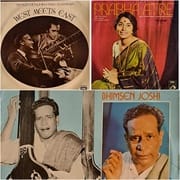
Evenings would bloom again if I could lose myself in the luminous voices of Pandit Jasraj, Pandit Bhimsen Joshi, Kishori Amonkar, Prabha Atre, and the deep, meditative dhrupad of Ustad Nasir Aminuddin Dagar.

And then, the weekend mehfil—friends gathered, hearts opened, and the air filled with the velvet ghazals of Mehdi Hassan, Begum Akhtar, Ghulam Ali, Munni Begum, Bhupinder, Pankaj Udhas, Salma Agha, and the soul-touching duets of Jagjit and Chitra Singh.

Some memories sing of nirguna bhajans by Kumar Gandharva—ethereal, abstract, and eternal. Others echo Meera bhajans, sung with such innocence and longing by Vani Jairam, composed divinely by Pandit Ravi Shankar. And then, the trance-like spell of Damadam Mast Kalandar, as rendered by Noor Jehan, Runa Laila, Reshma, Ghulam Nabi, and Saeen Akhtar.

Where did it all go? The Drums of India by J P Ghosh, the Fantasy of Indian Drums by Pandit Vijay Raghav Rao, Nayyara Sings Faiz, Jaam o Meena by Iqbal Siddiqi and Vandana Bajpai—where do such treasures reside now, if not in fading memories?

I wish, once more, to hear Bachchan’s Madhushala sung by Manna De, Sunderkand from Tulsi Ramayan by Mukesh, Soor Padavali by Pandit Jasraj, the qawwali of Ghungroo Toot Gaye by Maqbool Ahmed Sabri, and even Fun Time Rhymes by Preeti Sagar, which I played joyfully for my little son.

And sometimes, when nostalgia wears the perfume of romance, the songs from Sangam and Umrao Jaan return to whisper of love and longing.

Two records have etched themselves on my soul—West Meets East by Yehudi Menuhin and Ravi Shankar, and South Meets North by Lalgudi G Jayaraman and Amjad Ali Khan. East and West, South and North—what sublime confluences they were!

Would it be too much to ask the cosmos to return Savan Bhadon – Melody of the Rains to me? To bring back Bade Ghulam Ali Khan’s aching thumri “Aaye Na Balam”, to let me sway again with Sitara Devi to Kathak Dance of India, or be mesmerised by Vyjayanthimala’s grace on Bharat Natya?

Is there, I ask, anything more structured, more rhythmic, more perfect, more healing than Indian classical music? Is there anything more divine?

The soul of this music still breathes—it is we who must pause, and listen. For somewhere, beneath the clutter of digital noise, it still waits. The sarod still sighs. The flute still yearns. The tabla still celebrates. The tanpura still hums the eternal Om.

Let us, once again, tune our lives like an old tanpura—soft, steady, sacred. Let us reclaim that raga of existence, where each note is a prayer, and each silence, a sanctuary.

And maybe then, the music shall return.

♥♥♥♥

© Jagat Singh Bisht 

Laughter Yoga Master Trainer

LifeSkills

A Pathway to Authentic Happiness, Well-Being & A Fulfilling Life! We teach skills to lead a healthy, happy and meaningful life.

The Science of Happiness (Positive Psychology), Meditation, Yoga, Spirituality and Laughter Yoga. We conduct talks, seminars, workshops, retreats and training.

≈ Editor – Shri Hemant Bawankar/Editor (English) – Captain Pravin Raghuvanshi, NM ≈
Please share your Post !

Shares

English Literature – Memoir ☆ दस्तावेज़ # 25 – The Alchemy of becoming ☆ Shri Jagat Singh Bisht ☆ 

Shri Jagat Singh Bisht

(Master Teacher: Happiness & Well-Being, Laughter Yoga Master Trainer, Author, Blogger, Educator, and Speaker.)

(This is an effort to preserve old invaluable and historical memories through e-abhivyakti’s “दस्तावेज़” series. In the words of Shri Jagat Singh Bisht Ji – “The present is being recorded on the Internet in some form or the other. But some earlier memories related to parents, grandparents, their lifetime achievements are slowly fading and getting forgotten. It is our responsibility to document them in time. Our generation can do this else nobody will know the history and everything will be forgotten.”

In the next part of this series, we present a memoir by Shri Jagat Singh Bisht Ji “The Alchemy of becoming.“)

☆ दस्तावेज़ # 25 – The Alchemy of becoming ☆ Shri Jagat Singh Bisht ☆

As I sit quietly today, looking back at the journey I have lived, I see life not as a straight line but as a river—sometimes placid, sometimes tumultuous—always flowing. At a distance, it may appear a seamless continuum, but if you wade into its waters with care, you notice the whirlpools and tributaries, the rocks and banks, the many confluences that shaped the course. My own life has followed such a river’s path—like the Ganga, shaped by many turns, contributions, and inner transformations.

Like the holy Bhagirathi emerging from the Gangotri glacier, I too had a modest beginning. I was born in Ranjhi, a quiet suburb of the then sleepy town of Jabalpur. My early years flowed gently, in a world bounded by simplicity and schoolbooks, unaware of the larger world waiting beyond the next bend.

At sixteen, a turning point came—like the Bhagirathi meeting the Alaknanda at Devprayag and becoming the Ganga. It was my encounter with Brother Frederick, my Chemistry teacher and mentor, who first recognised the spark within me. He urged me to appear for the National Science Talent Search Examination, saying with conviction, “You have it in you.” His words became a catalyst, and when I secured a national ranking, my life took a decisive turn.

That achievement opened doors I hadn’t imagined—summer schools in Jaipur, Chennai, and Mumbai, rubbing shoulders with brilliant minds like Arunava Gupta, Pradip Mitra, and Rajiv Joshi. I began to see the world through the lens of science, logic, and curiosity. It was a time of identity formation—a scholar in the making.

But the river does not always follow the course we expect. Life, with its own currents, steered me into banking—a practical harbour for livelihood. Yet even there, destiny had something rich in store. I was selected to be a Behavioural Science Trainer. This was no ordinary role; it was a calling. The faculty at State Bank Staff College—Ravi Mohanty, Srinivasan Raghunath, and Santanu Banerjee—were not merely teachers; they were alchemists.

If my early years were a gentle river, this was the blast furnace stage of life. I was the raw iron ore—unshaped, full of potential—and they smelted me, transformed me, refined me. Alongside my dear colleagues Raghu Shetty and Prakash Divekar, I emerged stronger, sharper—like forged steel. It wasn’t just a change of skill but a transformation of being.

I conducted sessions on self-awareness, relationships, emotional intelligence—helping bank staff serve not just with efficiency but with empathy. But in teaching others, I learned the most about myself. My inner self, once a quiet stream, now bubbled with awareness, reflection, and the heat of change.

That transformation created a bridge to the next big chapter—my deep dive into the science of happiness and well-being. Positive Psychology gave me a new language to understand joy, fulfilment, and human potential. It reoriented my compass from achievement to meaning.

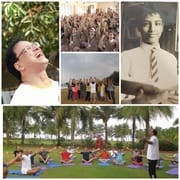
As retirement approached, one might think the river would slow. But rivers are strange—they gather force before meeting the sea. My wife and I became Laughter Yoga Master Trainers, mentored by the joyful duo Dr Madan and Madhuri Kataria. We found in laughter not just therapy but a sacred connection with others. It was like the Sangam at Prayagraj—where Ganga, Yamuna, and the invisible Saraswati meet. We were becoming whole.

Adding yoga and meditation to our lives, we were no longer just flowing—we were now merging with the ocean, carrying with us the essence of every experience, every person who shaped us, every soul we touched.

Looking back, it is clear—no achievement stands alone. Each is a ripple that causes another, building towards a life well-lived. From a curious boy in Ranjhi to a torchbearer of emotional intelligence and laughter, the river of my life has flowed through many lands. It has nurtured me, challenged me, and above all, made me more human.

Like Ganga, I hope I’ve left a trail of nourishment behind—and like the blast furnace, I hope I’ve emerged not just stronger, but purer.

Life is good. Life is meaningful. And if lived with awareness, even its small achievements can shape something truly vast.

♥♥♥♥

© Jagat Singh Bisht 

Laughter Yoga Master Trainer

LifeSkills

A Pathway to Authentic Happiness, Well-Being & A Fulfilling Life! We teach skills to lead a healthy, happy and meaningful life.

The Science of Happiness (Positive Psychology), Meditation, Yoga, Spirituality and Laughter Yoga. We conduct talks, seminars, workshops, retreats and training.

≈ Editor – Shri Hemant Bawankar/Editor (English) – Captain Pravin Raghuvanshi, NM ≈

Please share your Post !

Shares