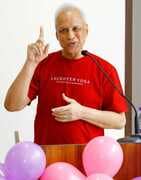
Shri Jagat Singh Bisht
(Master Teacher: Happiness & Well-Being, Laughter Yoga Master Trainer, Author, Blogger, Educator, and Speaker.)
Authored six books on happiness: Cultivating Happiness, Nirvana – The Highest Happiness, Meditate Like the Buddha, Mission Happiness, A Flourishing Life, and The Little Book of Happiness. He served in a bank for thirty-five years and has been propagating happiness and well-being among people for the past twenty years. He is on a mission – Mission Happiness!
☆ # 05: Effortless practices for Happiness and Stress Management ☆

BE A FREE SOUL
“I think, one must finally take one’s life in one’s arms.”
Arthur Miller
We are all born free. We have the potential to be winners. We have a right to be self-determining. An authentic person experiences self-reality by knowing, being, and becoming a credible, responsive person.
We all have within us a child, an adult, and a parent. This becomes apparent when we respond differently to different situations – exhibiting fear, playfulness, balance, self-control, hatred, love, and compassion.
Sometimes we are childlike – full of feelings and emotions – laughing, crying, jumping, shouting, and screaming. At times we behave like an adult – fully aware and organized – oriented to the current reality. On other occasions, we tend to be like parents – critical and prejudicial – and often nurturing too!
Every state of mind is equally important and there is a time for it. There is a time to work and a time to play, a time to laugh and a time to cry, and a time to speak and a time to be silent.
We are all born free. We have the potential to be winners. We have a right to be self-determining. An authentic person experiences self-reality by knowing, being, and becoming a credible, responsive person.
Autonomy is a human birthright. Being autonomous means being self-governing and determining one’s own destiny. A slave can never be happy. A slave can never flourish.
According to Stephen Covey, “Every human has four endowments – self-awareness, conscience, independent will and creative freedom. These give us the ultimate human freedom… These give us the power to choose, to respond, and to change.”
We must begin by taking responsibility for our own actions and feelings. We must also learn to throw off patterns that are irrelevant and inappropriate to living in the here and now.
The litmus test of a truly autonomous person lies hidden in three fundamental capacities – awareness, spontaneity, and intimacy.
AWARENESS
Awareness is knowing what is happening now. An autonomous person is aware. His body and mind are in unison in the here and now. It is not that the body is physically present somewhere and the mind is wandering elsewhere.
One must not only be fully present but also fully aware of the situation, surroundings, and feelings of self and others. The decisions taken must depend upon the facts of the situation and not on some pre-conceived notions. Prejudices from the past must not impact actions in the present.
An autonomous person looks objectively at the situation in the present, listens attentively, seeks clarifications to arrive at a deeper understanding of the situation, and arrives at a balanced decision without being influenced by opinions.
One must be in touch with one’s feelings and sensations in the body. If you are tense, your breath is shallow. You can relax by taking a few deep breaths and exhaling in a relaxed manner. That will help you clear your mind and make a better decision.
Always listen to the other person with empathy, do not interrupt, and ask questions that help you understand the person in the right perspective. Do not form opinions about the person based on what you have been told earlier. Keep your mind open, make your own observations, and arrive at your conclusions based on the facts before you.
You must be fully present there. Fully mindful. Do not let your attention wander hither and thither. Let past prejudices and opinions not influence you. Be your own witness. Decide on your own based on the merits of the case. Take full responsibility of the decision taken by you. Be honest and upright.
Sometimes our parental influences crop up to affect our decisions or the playful child contaminates our thinking. One must be vigilant and must be in the right frame of mind, always fully aware, to make the right decisions in the here and now.
SPONTANEITY
You must have the spontaneity to choose from a whole range of behaviour that the child, adult, and parent residing within you prompt you to adopt. Your decisions must not always along the pre-decided patterns that you have been accustomed to witnessing for ages.
Spontaneity denotes choosing the right actions from a wide range of possibilities. You must choose the option that you find appropriate, as per your inner voice, and accept full responsibility for the decision. Let not your inner child or parent influence you, do not be victim of confusing voices from the past. Be analytical, choose what you find appropriate, and feel relaxed.
If you arrive at free and independent decisions, without being swayed by feelings and prejudices, you will not experience stress. You will be happy. Spontaneity helps you to be autonomous and take control of your destiny.
An autonomous person is spontaneous and flexible – not rigid and impulsive. The person is free despite basic instincts or drives, free despite inherited characteristics and environmental influences. An autonomous person can be realistic and choose from the entire spectrum of behaviour appropriate to the situation.
INTIMACY
Intimacy is expressing feelings of warmth, tenderness, and closeness toward others. One must shed masks and old programming, if any, and be warm toward people. One should not be sarcastic or play games with people. One should learn to let go and develop a capacity for intimacy.
People moving toward autonomy expands their personal capacities for awareness, spontaneity, and intimacy. Once you are open and have no conflicting voices within, you are in full control. There is no tension. You feel happy.
EXERCISE
Look inward to know yourself deeper.
Spare a few moments for yourself in a quiet place.
Just ponder:
How often do you behave like a child? Do you sulk or get angry often? Do you still laugh and play like a child?
What parental influences have you inherited? Do you have too many rigidities and prejudices? Are you nurturing and kind toward people?
How often do you analyse situations impartially? Are you aware of the circumstances and feelings of others? Do you make decisions in the here and now?
Are you still carrying burdens from the past that you would like to shed off?
How stressed do you feel?
Do you feel happy, content, and peaceful?
Are you doing your best under the situations?
What changes would you like to make in your life?
Where do you see yourself five years from now, ten years from now?
Take your own time. No hurry.
Get back to the questions that you feel are important and give a second thought.
Keep exploring. Try to be better and better every day.
You will feel liberated and on control of your destiny.
THE PARABLE OF THE EAGLE
Have you heard of the parable of the eagle? The parable is paraphrased beautifully in ‘Born to win’:
“Once upon a time, while walking through the forest, a certain man found a young eagle. He took it home and put it in his barnyard where it soon learned to eat chicken feed and to behave as chickens behave.
“One day, a naturalist who was passing by inquired of the owner why it was that an eagle, the king of all birds, should be confined to live in the barnyard with the chickens.
“Since I have given it chicken feed and trained it to be a chicken, it has never learned to fly,” replied the owner. “It behaves as chickens behave, so it is no longer an eagle.”
“Still,” insisted the naturalist, “it has the heart of an eagle and can surely be taught to fly.”
“After talking it over, the two men agreed to find out whether this was possible. Gently the naturalist took the eagle in his arms and said, “You belong to the sky, and not to the earth. Stretch forth your wings and fly.”
“The eagle, however, was confused; he did not know who he was, and, seeing the chickens eating their food, he jumped down to be with them again.
“Undismayed, the naturalist took the eagle on the following day, up on the roof of the house, and urged him again, saying, “You are an eagle. Stretch forth your wings and fly.” But the eagle was afraid of his unknown self and world and jumped down once more for the chicken food.
“On the third day the naturalist rose early and took the eagle out of the barnyard to a high mountain. There, he held the king of birds high above him and encouraged again, saying, ”You are an eagle. You belong to the sky as well as to the earth. Stretch forth your wings now, and fly.”
“The eagle looked around, back towards the barnyard and up to the sky. Still, he did not fly. Then the naturalist lifted him straight towards the sun and it happened that the eagle began to tremble, slowly he stretched his wings. At last, with a triumphant cry, he soared into the heavens.
“It may be that the eagle still remembers the chickens with nostalgia; it may be that he occasionally revisits the barnyard. But as far as anyone knows, he has never returned to lead the life of a chicken, He was an eagle though he had been kept and tamed as a chicken.”
Be a winner. Go, kiss the world!
“It takes courage to be a real winner – not a winner in the sense of beating out someone else by always insisting on coming out on top – but a winner at responding to life. It takes courage to experience the freedom that comes with autonomy, courage to accept intimacy and directly encounter other persons, courage to take a stand in an unpopular cause, courage to choose authenticity over approval and to choose it again and again, courage to accept the responsibility for your own choices, and, indeed, courage to be the very unique person you really are.”
Born to Win/ Muriel James and Dorothy Jongeward
“Stretch forth your wings and fly!”
James Aggrey
♥ ♥ ♥ ♥
© Jagat Singh Bisht
Master Teacher: Happiness & Well-Being, Laughter Yoga Master Trainer, Author, Blogger, Educator, and Speaker
Founder
A Pathway to Authentic Happiness, Well-Being & A Fulfilling Life! We teach skills to lead a healthy, happy and meaningful life.
The Science of Happiness (Positive Psychology), Meditation, Yoga, Spirituality and Laughter Yoga. We conduct talks, seminars, workshops, retreats and training.
≈ Editor – Shri Hemant Bawankar/Editor (English) – Captain Pravin Raghuvanshi, NM


