Laughter Yoga: How to do it all alone for 10 minutes everyday
Learning Video for Laughing Alone
Laughter is the best medicine.
To get all the health benefits of laughter, you need to laugh deep and continuously for 10-20 minutes. How to do that every day when you are all alone? This video is a tutorial for that.
Laughter Yoga is usually done in groups. People find it difficult to practise it on a daily basis by themselves.
Laughter Yoga is a unique concept where anyone can laugh for no reason without relying on humour, jokes or comedy.
The concept is based on a scientific fact that the body cannot differentiate between real and fake laughter if done with willingness. One gets the same physiological and psychological benefits.
Dr Madan Kataria, a medical doctor, founded the first Laughter Club with just five members in Mumbai in the year 1995. Today there are thousands of laughter clubs all over the world where laughter is initiated as an exercise in a group but with eye contact and childlike playfulness, it soon turns into real and contagious laughter.
It is called Laughter Yoga because it combines laughter exercises with yoga breathing. This brings more oxygen to the body and the brain which makes one feel more energetic and healthy.
When we laugh, our body generates feel good hormones called endorphins which improve our mood and general outlook. During laughter exercises, all the stale air inside the lungs is expelled and our system gets more oxygen which enhances the immune system. In the long run, the inner spirit of laughter helps you build more caring and sharing social relationships, and laugh even when the going in not good.
Why one should not speak a deliberate lie even in jest.
[1]
One day the Buddha came to Rahula, pointed to a bowl with a little bit of water in it, and asked: “Rahula, do you see this bit of water left in the bowl?”
Rahula answered: “Yes, sir.”
“So little, Rahula, is the spiritual achievement of one who is not afraid to speak a deliberate lie.”
[2]
Then the Buddha threw the water away, put the bowl down, and said: “Do you see, Rahula, how that water has been discarded?
“In the same way, one who tells a deliberate lie, discards whatever spiritual achievement he has made.”
[3]
Again, he asked: “Do you see how this bowl is now empty?
“In the same way, one who has no shame in speaking lies is empty of spiritual achievement.”
[4]
Then the Buddha turned the bowl upside down and said: “Do you see, Rahula, how this bowl has been turned upside down?
“In the same way, one who tells a deliberate lie turns his spiritual achievement upside down and becomes incapable of progress.”
[5]
Therefore, the Buddha concluded, one should not speak a deliberate lie even in jest.
I teach what everyone seeks but finds it difficult to achieve. It remains more and more elusive as one chases it. Everyone believes he knows everything about it but is, in fact, ignorant and often misguided. I am talking about happiness and well-being.
According to Sonja Lyubomirsky, Professor of Psychology at the University of California, Riverside, “One of the greatest obstacles to attaining happiness is that most of our beliefs about what will make us happy are in fact erroneous. Yet they have been drummed into us, socialized by peers and families and role models and reinforced by the stories and images ever present in our culture. Many of the presumed sources of happiness seem so intuitive and commonsensical that all of us – even happiness researchers! – are prone to fall under their spell.”
The happiness myths need to be understood and overcome. You can teach yourself to be happy. The art and science of happiness and well-being can be learned and taught.
At LifeSkills, we have gone deep to blend the best of the modern science of Positive Psychology with the ancient wisdom of Yoga and Meditation. We have added a dash of Laughter Yoga into the cask to make it sparkle. Our programmes show the pathway to authentic happiness, well-being and fulfillment. We help you to flourish!
Happiness and well-being is not a thing. The modern science of happiness and well-being describes it as a ‘construct’.
For example, ‘weather’ is a construct. Ask any meteorologist, and he will tell you: weather is not a thing, it is a construct – a construct of temperature, humidity, barometric pressure, wind speed and a host of other factors.
The elements of well-being include positive emotion, engagement or flow, positive relationships, meaning and accomplishment.
A couple of additional features from out of self-esteem, optimism, resilience, vitality and self-determination are required to really flourish.
This means you have to dig a bit deeper to understand fully what is happiness and well-being. It’s not as simplistic as saying: happiness is within us.
Happiness does not come to you on its own. You have to act in order to achieve it.
The good news is that we can learn to enhance our levels of happiness and well-being.
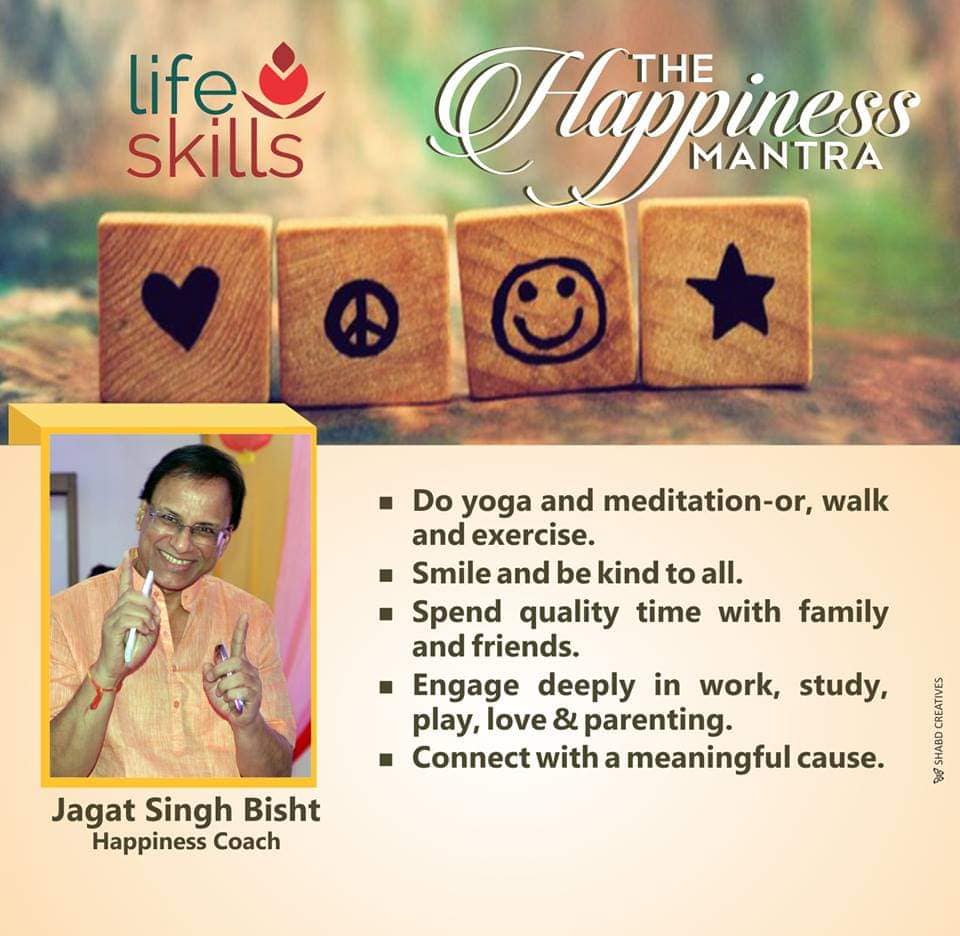
Everyone wants to be happy. Here are some simple happiness mantras:
Every morning, do yoga and meditation – or walk and exercise.
During the day, smile and be kind to all.
In the evening, look back at 3 things that went well in the day.
During the week-end, spend quality time with your family and friends.
Engage deeply in work, studies, play, love and parenting.
Devote yourself to a meaningful humanitarian or social cause.
Share an occasional ice-cream or chocolate with a child.
Every person seeks happiness, peace and harmony. But often stumbles upon misery, stress and dis-content. Then, starts a journey. Each one takes a different route.
The most common route leads to a pleasant life. A life of material comfort and luxury. One studies in a good school, goes to the university and finds a rewarding job and climbs up and up the ladder. Or, he starts his own business, and flourishes. Such a life is a life full of pleasures. At times, this person wonders – am I really happy?
You may choose a different track. The road less traveled. You are passionate about something and love doing it. You get so absorbed in the activity that you lose track of time, even yourself. Such a life is a life of flow, an engaged life. You may find gratification in sport, science, design, or cooking. This is good life. One uses her signature strengths on an ongoing basis and feels happy.
Some others search for meaning in their lives. They have the greater good of humanity in their minds. They seek happiness for themselves and all around them. They strive for, and acquire, right wisdom and are full of compassion for others. One such enlightened soul visited this planet about two thousand and five hundred years ago. He saw misery all around and, by deep meditation, discovered a way out of it. That is why he is known as ‘Tathagata’ – one who has walked the Path and known the Truth! The path is the eight-fold noble path of morality, mindfulness and wisdom. Such a life is a meaningful life.
Swami Vivekananda, it seems, preferred a meaningful life over others. He once said, “They only live who live for others. Others are more dead than alive!”
But you may choose the life you wish to live. You can choose a pleasant life, or an engaged one, or a life full of meaning. You can aspire to be a Buddha, and you too can become a Buddha – the Enlightened One! The choice is totally yours.
As the Enlightened One blessed us: Bhavatu sabba mangalam! May all beings be happy!
“Vipassana means seeing things as they really are. It is the process of self-purification by self-observation.”
S N Goenka
Vipassana is one of India’s most ancient meditation techniques. Long lost to humanity, it was rediscovered by Gautama Buddha more than 2500 years ago…
A golden gateway to vipassana meditation is the 10-day vipassana course taught by S N Goenka in hundreds of centres all over the world. It initiates you to the technique beautifully and launches you successfully into the orbit of self-awareness and self-purification.
A human mind is often compared to a monkey – jumping all around. Vipassana is not just a technique to calm the mind or enhance concentration. It goes much beyond that. It purifies the mind of all impurities of craving, aversion and ego.
Goenka follows a scientifically structured three-dimensional approach taught to him by his Burmese Teacher Sayagyi U Ba Khin. The technique as practiced by Buddha was preserved and passed on from generation to generation in its pure form in the Dhamma land now known as Myanmar.
The first dimension refers to discipline and moral conduct. Known as ‘Sheela’, this lays a strong foundation for the practice. During the course, the students maintain noble silence which means no verbal or non-verbal communications of any kind, no gestures, no physical touch and eyes downcast. Nutritious and wholesome food is served for breakfast and lunch. There is evening tea and simple snacks. No dinner. Your day starts at 4 a.m. and before 10 p.m. all lights are off. You clean your own room and wash your plates. No intoxicants or smoking for the duration.
On paper, this may look difficult to observe. But I have seen youngsters in their twenties’ and thirties’, the middle-aged and the old, and men and women of different nationalities comply with the code of conduct without any difficulty. In fact, it feels good. You get a first-hand feel of a monk’s life!
The second dimension is about taming the monkey mind. It is called ‘samadhi’ or concentration. Initially, we start with focussing our attention on our natural breath as it is. Yes, it seems difficult in the beginning. The mind simply sets to wander. Instead of meditating, your mind gets lost in fantasies. You find it very difficult to bring it back. After two or three days, the wandering lessens and you are there more and more.
Once you start experiencing a bit of focus, you move on to vipassana – purification of the mind. It begins with simple observation of your sensations. Then, we go deeper and deeper. Depending on how hard and diligently you work during the course, your experiences may be different, at different levels – gross or subtle.
Don’t ever think you will attain Buddhahood in these ten days. You just get introduced to the technique. Thereafter, it’s your hard work. It may take years, even whole life, sometimes many births. Don’t expect to see some Divine light or experience a state of sweet bliss. The process of metamorphosis or purification may be painful indeed. Be ready!
The third dimension is ‘panya’ or wisdom. Through daily discourses in the evening, insights are given into the activities during the day and the philosophy behind it. Nuggets of pure dhamma gradually build-up right understanding. The morning chanting and dohas give you fodder for thought.
On the tenth day, we practice ‘metta’ bhavna meditation. We wish happiness, peace and harmony for all beings. All our cravings, aversion and ego start dissolving by now. We feel lighter, better, transformed – ready to tread on the path of Dhamma, filled with gratitude towards Buddha who understood the misery of mankind and devised a tool to eradicate it.
The ultimate learning and insight we develop: May all beings be happy! Bhavatu sabba mangalam!
Nirvana is an Illusion, Serving for a Cause is Divine
I am penning this piece on the banks of the holy Ganga in the sacred land of Sages and Rishis on the foothills of the Himalayas.
I feel blessed as I am attending an international festival of yoga in Rishikesh. Around me are more than a thousand yoga gurus and yogis from more than a hundred countries. It is but natural to feel high on yoga, meditation and spiritual discourses from 4 am to 10 pm.
Last night was a restless one for me. Thoughts moved as fleeting clouds the whole night in my mind. Is nirvana a necessity or a luxury? Is it for real? Or, is it an illusion, delusion, confusion, or hallucination created by the spiritual guys?
I am an old man now by worldly standards. Even then, I stand on the crossroads like an Arjuna on the battle ground of Kurukshetra, with no Krishna around.
All my life, I tried all the available faiths and doctrines by hit and trial. I did not find much solace anywhere. Finally, I saw a silver lining – the path of the Buddha. Meditation is the quintessence of his teachings. I started practicing it.
I am just a step away from nirvana. Nirvana looks down upon me and gives a wry smile. I feel I am not interested in taking the next step. It seems futile. What will anyone else gain if I am enlightened?
I have seen the glow in the eyes of spiritual persons at the sight and smell of dollars. And feel saddened when they ignore us who have the most valuable currency – authenticity and happiness. It really hurts.
I do have a few vices remaining – ego which erupts from time to time, aversion towards those who play games, and craving for the beautiful ones. I sometimes feel that I am a sexual volcano on a human, spiritual journey.
I tried to attain all the perfections and succeeded to some extent. I admit that I have not been able to develop patience, temperance and humility. Why should I be polite to the hypocrites, scoundrels and rascals?
As I told you, I am almost in the neighborhood of Nirvana but I am not interested now. I feel disillusioned by the very concept of nivana.
Nirvana is non-productive. It makes people idle and alienates them from real world and their duties. To be here and now in the present moment, I feel one should be totally engaged in work, play, love and relationships. That is true happiness!
I feel the best form of spiritual life is serving for a social or humanitarian cause. One should strive to be a Mother Teresa, a Gandhi, a Martin Luther King, an Abraham Lincoln or a Malala or Satyarthi, instead of chasing a mirage called nirvana.
Vipassana Meditation: All You Wanted to Know About the 10-Day Retreat
Vipassana is an ancient technique of meditation discovered by the Buddha more than two thousand and five hundred years ago. It is non-sectarian and open to people of all colour and creed.
The 10-day retreat of silence and meditation is a unique experience which everyone should have at least once in lifetime. It’s a boot camp for the mind and gives you a first-hand feel of virtue, mindfulness and wisdom.
During the tenure of the course, you observe five precepts: abstaining from killing, stealing, sexual misconduct, lies and intoxicants.
You wake up at 4 am and meditation begins at 4.30 am. All through the day, you meditate, meditate and meditate! Of course, you have breaks for breakfast, lunch and evening meals. You are in your bed by 9.30 pm.
The accommodation is simple and hygienic, with basic amenities. No television. No internet. You live like a monk/nun for ten days of your life.
The food is simple and nutritious. Some people have an impression that they might starve there. That’s not correct.
On the zero day, you have to report at the centre by afternoon. You are required to deposit your mobile phone, cash and valuables in a locker allotted to you.
Please carry simple and comfortable clothing with you for the course. Don’t carry too many of those. Laundry service is usually available at the centre.
What you learn in the ten days is truly valuable and often life transforming. For the first three days, you learn to concentrate by focussing on your breath, next six days are for gaining insight into your body and mind, and on the last day you enjoy the bliss of loving kindness meditation.
The course also guides you subtly to a routine of moral discipline, purity of mind and loving kindness for all beings.
You learn the basic technique there and then go back home to continue meditating and progressing in the path of spirituality.
The course gets over on the eleventh day at 7 am.
It’s an experience you will cherish, adore and would like to repeat frequently!
You may register for a 10-day course at the global website for Vipassana Meditation.
May your life be filled with happiness, love, peace and tranquillity!