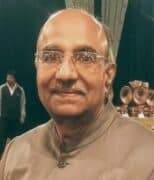
(We present an article ‘Entering My 80th Year… Count your blessings, not your troubles’ written by Shri Ajeet Singh ji, Ex-Director (News), Door Darshan.)
☆ Entering My 80th Year… Count your blessings, not your troubles… ☆ Shri Ajeet Singh ☆
(November 2025)
About ten months before India woke up to freedom in 1947, a farmer in a village near Panipat celebrated the birth of his first son. He had waited years for this moment. He had married four times—his first three brides, married in childhood as per the tradition of those times, passed away due to illness. His fourth wife, nearly twenty years younger than him, finally fulfilled his dream by giving birth to a son.
Being born on the eve of India’s independence felt like a blessing in itself.
Around the same time, a long-drawn court case over a piece of village land—after a bloody clash—was finally decided in the farmer’s favour. He believed he had won not through legal brilliance but through sheer strength.
So he named his son Baljeet — the one who wins through strength — hoping the boy would fight life’s battles with physical might.
But destiny had other plans.
The child grew up to gain the strength of education instead. His friends called him Jeeta, and the village schoolteacher recorded his name as Ajeet Singh. For a boy from a village with no electricity, no tap water, no paved streets and only mud-brick houses—becoming the first graduate of the village was a blessing beyond measure.
Following tradition and his ailing father’s wish, he was married even before he had cleared his matriculation exam. His young bride turned out to be the perfect partner—standing by him through every storm. Another precious blessing.
A graduate of Kurukshetra University in 1967, he cleared the UPSC’s Indian Information Service exam in 1970. His first posting was at All India Radio, Shimla as a Sub-Editor. A beautiful hill station for a first job was a blessing. A bigger blessing was that this is where he learned the art and soul of radio journalism. For a boy from a small village, this became the perfect grooming ground.
History kept unfolding before his eyes. From the Shimla Agreement after the Indo-Pakistan war to nearly 35 years of reporting across corridors of power in Himachal Pradesh, Jammu & Kashmir, and Haryana—his journey was remarkable.
He reported from Srinagar in the militancy infested, turbulent 1990s—covering the terrorist siege at Hazratbal Shrine, and the Kargil War. That Srinagar posting was a real test of grit—but a blessing nonetheless, for in 1990 he received All India Radio’s Best Correspondent Award.
A four-year stint in New Delhi deepened his understanding of broadcast journalism.
His last posting was at the newly opened Doordarshan Kendra, Hisar, where he learned the ropes of television journalism. During his AIR and DD career, he covered Prime Minister’s visits to three foreign countries and equal number of Presidential foreign visits.
Shri Ajeet Singh – A Media Man at 79.
He retired in 2006 as Director News, Doordarshan Hisar. For a village boy to rise to Director level—was that not a blessing? None of his classmates had achieved anything similar.
Retirement, too, has been a joyful 19-year blessing. As a founding member of Vanaprastha, a voluntary senior citizens’ group, his writing blossomed. Initially, he wondered what he would do after retirement—no press notes, no newsroom invites.
Then he discovered stories of the ordinary persons. The media rarely covers them, yet every person has an extraordinary story to tell. He listened, wrote in his own style, and people loved it. Local media and friends encouraged him, and his storytelling found new wings.
Even the Covid-19 period nourished his writing. Retired IIS colleagues started writing experience-based essays. These were later compiled into a book—ten of those essays were mine.
Yes, I am that boy who was blessed so abundantly.
Technology became another silent companion. The smartphone is a magical fusion—my typewriter, my stenographer. I speak; it types. Google is like Aladdin’s Genie—ready with answers at one command. WhatsApp is my graceful courier—carrying messages to and from friends. If only such tools existed during my service years! Today, they are yet another blessing.
I often feel that journalism doesn’t count its blessings enough. It remains trapped in sufferings, conflicts, and crises—and in doing so, may actually magnify them.
Through my good stories, am I perhaps making amends for my past journalistic “sins”? Readers will decide. But I know this: telling the stories of common people fills me with joy. For every person carries many beautiful and exclusive stories within.
On my 80th birthday, 5th November, I seek your blessings once again.
Life had its fair share of struggles and stress—but time melted them away. Why count them, when nature has showered countless blessings?
I count my blessings, not my sorrows.
To me, that is the right way to live.
Do you feel the same way? Comment—who knows, we may discover a story right here.
Authored six books on happiness: Cultivating Happiness, Nirvana – The Highest Happiness, Meditate Like the Buddha, Mission Happiness, A Flourishing Life, and The Little Book of Happiness. He served in a bank for thirty-five years and has been propagating happiness and well-being among people for the past twenty years. He is on a mission – Mission Happiness!
😎 गर्दिश के दिन: Days of Despair 🥸
(हिंदी और अंग्रेजी में एक मिश्रित / A bilingual experiment in Hindi and English)
काफी समय पूर्व, एक प्रतिष्ठित पत्रिका में, कई लेखकों ने अपने गर्दिश के दिनों पर लिखा था। उन्होंने सफल और महान होने के बाद, संपादक के आग्रह पर, ऐसा किया था। मैं सफल और महान हुए बिना, ऐसा अपनी मर्जी से कर रहा हूं।
उम्र के अनेक मोड़ पार कर चुका हूं। अब तक न सफल हुआ हूं और न ही महान बन पाया हूं। मेरे देखते-देखते, मुझसे कम योग्य लोग मुझसे अधिक सफल हो चुके हैं और मुझसे घटिया लोग महान बन गए हैं। यही मेरे दुख का कारण है।
A long time ago—long enough for nostalgia to acquire a few grey hairs of its own—a reputed Hindi magazine brought out a remarkable series. It was dedicated to the days of despair of celebrated writers: tales of their hollow pockets, hollow kitchens, and occasionally hollow souls. The contributors were friendly luminaries who had, by then, climbed to heights from where despair looked like a poetic childhood disease—painful at the time, but now excellent material for charming anecdotes at literary gatherings.
They wrote of wretched rooms where even hope hesitated to enter; they narrated the evenings when the lamp had more soot than light, and the mornings when fortune seemed to have overslept on purpose. Their stories reminded us that greatness, like good compost, must sprout from organic suffering.
They were invited by the Editor because they were great, famous, and suitably wrinkled by experience.
I, however, attempt the same task without possessing greatness, fame, or even the sort of wrinkles that literary editors find aesthetically inspiring. If anything, mine are plain domestic creases, the ordinary lines produced by old age and electric bills.
I have grown old—old enough to avoid mentioning numbers, lest someone mistakes my age for a historical period—but alas, greatness has not arrived. Nor has fame. Nor has even that modest rumour that “someone in our locality is doing something interesting.” I have waited politely. Greatness, it seems, has not reciprocated the courtesy.
What adds flavour to this mild tragedy is that, as the years have trotted past, I have seen—quite helplessly—the rise of men lesser, meaner, and, in some extreme cases, louder than me. They flourished with the ease of mildew in monsoon. Every time a new one rose, I experienced an unhappiness so refined and aristocratic that Oscar Wilde himself might have complimented it.
My friends, naturally, have prospered beyond belief. Their bungalows are so large that one needs Google Maps to locate the guest bathroom. Their chauffeur-driven luxury cars glide through town like well-bred crocodiles. Their wives, robust in both health and wealth, supervise homes where everything—including the dogs of foreign breed—has a higher market value than my bank balance. They possess vast fortunes in Swiss banks, majestic collections of fat, cholesterol, high blood pressure, diabetes, and heart disease. I possess none of these. Not even the cholesterol.
I am a tortoise. They are hares—and some, on festive days, hunt with the hounds too. But before you assume I lack talent or refinement, let me clarify with the humility of a saint and the accuracy of a government form: I am physically, mentally, and spiritually sound; honest to a degree that makes honesty awkward; and financially and intellectually cleaner than freshly laundered linen.
My achievements—scattered across reading, writing, sports, games, love, sex, and friendship—are enough to fill a respectable diary, if not a library. But I cannot bring myself to practise sycophancy. I cannot flatter a man merely because he has a necktie and a position. Had I embraced hypocrisy with the enthusiasm of my peers, I, too, might have gathered a following of disoriented devotees. But shame is a stubborn thing.
Over time, I have read the autobiographies of the great. They describe how they saw poverty, hunger, disease, famine, and other educational experiences; how they struggled bravely, laboured endlessly, and rose steeply; how they eventually reached the mountaintop, from where everything below looked small—especially other people’s problems.
And then, feeling generous, they shared the stories of their struggles for the benefit of lesser mortals.
I, unfortunately, do not believe in shortcuts. As I read and write and wander into the dense forest of spirituality, I realise that a vast world remains unconquered. And I, firmly stationed at the starting point, can only wave at potential as it passes by.
So here I am—no one, nowhere—trudging along with my despair and gloom walking faithfully beside me, like two old companions who have tired of trying to cheer me up and now simply keep pace out of habit.
Greatness may yet arrive. Fame may yet stumble upon me. But until then, I shall continue writing pre-fame memoirs of despair, hoping they will someday become post-fame classics.
After all, even a tortoise deserves a footnote in literary history.
लोगों ने गरीबी देखी, भूख देखी, अकाल देखा, बीमारी देखी, संघर्ष किया, साधना की, और महान हो गए। महानता के शिखर पर पहुंचने के बाद, वो पीछे मुड़कर अपने गर्दिश के दिनों पर विहंगम दृष्टि डाल सकते हैं। यह उनका सौभाग्य है।
सफलता के टीले पर, शॉल ओढ़े बैठकर, गर्दिश के दिनों को याद करने की रूमानियत मेरे नसीब में नहीं है। जितना पड़ता जाता हूं, उतना ही पाता हूं कि अभी तो अनंत आयाम बाकी हैं जानने को। जितना लिखता जाता हूं, उतना ही पाता हूं कि कलम बहुत छोटी है और स्याही बहुत कम। मेरी गर्दिश और गहराती जाती है।
झूठमूठ की सफलता और महानता के शॉर्टकट मैं नहीं पकड़ पाता। मेरी गर्दिश मेरे संग-संग चलती है!
(इस रचना के हिंदी अंश तीस बरस पहले लिखे गए थे और अंग्रेज़ी वाला हिस्सा अब लिखा है।
The Hindi portion of this article was written thirty years ago and the English portion has been blended now.)
A Pathway to Authentic Happiness, Well-Being & A Fulfilling Life! We teach skills to lead a healthy, happy and meaningful life.
The Science of Happiness (Positive Psychology), Meditation, Yoga, Spirituality and Laughter Yoga. We conduct talks, seminars, workshops, retreats and training.
Dr. Suresh Kumar Mishra, widely known in the world of satire by his pen name ‘Uratipt’, expresses his emotions and thoughts with profound honesty and depth. His multifaceted talent is evident in his contributions across various literary genres. He is not only a renowned satirist but also a poet and a children’s author.
His satirical writings have earned him a special place in the literary world. His satire, ‘Shikshak Ki Mout’, went massively viral on the Sahitya Aajtak channel, garnering over a million views and reads—a monumental achievement in the history of Hindi satire. His collection of satires, ‘Ek Tinka Ikyavan Aankhen’ (A Straw and Fifty-One Eyes), is also highly acclaimed and includes his timeless work, ‘Kitabon Ki Antim Yatra’ (The Last Journey of Books). Other celebrated collections include ‘Mayaan Ek, Talwar Anek’ (One Sheath, Many Swords), ‘Gapodi Adda’ (The Gossiper’s Den), and ‘Sab Rang Mein Mere Rang’ (My Colors in Every Hue). His satirical novel, ‘Idhar-Udhar Ke Beech Mein’ (In Between Here and There), is a unique and groundbreaking work focused on the third world.
His significant contributions to literature have been widely recognized. He was honored with the Best Young Creator Award, 2021 by the Telangana Hindi Academy and the Government of Telangana, an award presented by Chief Minister K. Chandrasekhar Rao. The Rajasthan Children’s Literature Academy also honored him for his children’s book, ‘Nanhon Ka Srijan Aasmaan’ (The Creative Sky of Little Ones). Additionally, he has received the Vyanga Yatra Ravindranath Tyagi Sopaan Samman and the Sahitya Srijan Samman from Prime Minister Narendra Modi.
Dr. Uratript has also played a pivotal role in writing, editing, and coordinating a total of 55 books for the Government of Telangana for primary school, college, and university levels. His work is included in university textbooks in Bihar, Chhattisgarh, and Telangana, where his satirical creations are part of the curriculum. This recognition underscores that young readers can identify and appreciate quality and impactful writing.
Key Accolades and Works
Viral Satire: ‘Teacher’s Death’ (over 1 million views)
Unique Satirical Novel: ‘Idhar-Udar Ke Beech Mein’
Awards: Shreshtha Navyuva Samman (Telangana), Sahitya Srijan Samman (PM Modi), and more.
Educational Contribution: Authored and edited 55 books for the Telangana government.
Some precious moments of life
Honoured with ‘Shrestha Navayuvva Rachnakar Samman’ by former Chief Minister of Telangana Government, Shri K. Chandrasekhar Rao.
Honoured with Oscar, Grammy, Jnanpith, Sahitya Akademi, Dadasaheb Phalke, Padma Bhushan and many other awards by the most revered Gulzar sahab (Sampurn Singh Kalra), the lighthouse of the world of literature and cinema, during the Sahitya Suman Samman held in Mumbai.
Meeting the famous litterateur Shri Vinod Kumar Shukla Ji, honoured with Jnanpith Award.
Got the privilege of meeting Mr. Perfectionist of Bollywood, actor Aamir Khan.
Meeting the powerful actor Vicky Kaushal on the occasion of being honoured by Vishva Katha Rangmanch.
Today we present his satire The Algorithm’s Chalkboard.
☆ Witful Warmth# 67 ☆
☆ Satire ☆ The Algorithm’s Chalkboard… ☆ Dr. Suresh Kumar Mishra ‘Uratript’ ☆
The year is no longer the year of our Lord, but the year of the Algorithm, and the school—that hallowed sanctuary where wisdom was once whispered—has become a mere content creation factory. Oh, the sublime tragedy! We once spoke of pedagogical excellence and the depth of the Socratic method; now, we speak only in terms of conversion rates and the optimal time to post a twelve-second explainer on quantum physics set to a trending K-Pop beat. The new mandate, delivered with the sterile, smiling cruelty of a managerial seminar, is this: Teachers are to be ranked not by the sediment of forty years’ experience, but by the ephemeral, shimmering dust of TikTok follower counts. Experience, that grand old ruin, is deemed a liability, a sign of one’s inability to adapt to the short attention span economy. Knowledge is burdensome; flash is the currency. A teacher’s salary, promotion, and even the size of their classroom depend on a number that fluctuates with the whims of a fifteen-year-old scrolling past a tragicomic dance challenge. The wisdom earned through silent years in libraries is worthless compared to the ability to make one’s face look surprised in a viral ‘reaction’ video. This is the new enlightenment, a light so bright it blinds us to the very purpose of education, transforming temples of learning into sound stages for absurdity. This is not progress; it is the ultimate, mind-blowing mockery of intellect by the mass market, delivered on a tiny screen.
The central tragedy is embodied by Acharya Gyaneshwar, a man whose 40 years of service had etched a map of human knowledge onto his soul, and whose Ph.D. in Sanskrit had been earned through a lifetime of quiet sacrifice. He moves through the fluorescent-lit hallways like a ghost from a sensible past, clutching his worn copy of the Upanishads, now treated with less respect than a discarded fidget spinner. His colleague, twenty-two-year-old Ms. Sparkle, whose primary qualification is 5.2 million followers, dictates the new faculty meeting agenda. Acharya Gyaneshwar, whose lectures used to inspire students to look beyond the immediate, is now assigned the dankest corner classroom because his “engagement metrics are catastrophically low,” a phrase that, in the new language of the school, means his soul is too pure for their shallow enterprise. Ms. Sparkle, meanwhile, is granted the state-of-the-art auditorium for her live-streamed “Math Magick” sessions, which largely consist of her pointing dramatically at a whiteboard while a filter gives her cat ears. The heartbreaking irony is that she cannot explain basic trigonometry, yet she defines the institution’s success. Acharya Gyaneshwar’s voice is soft, rich with wisdom; Ms. Sparkle’s is loud, amplified by the hollowness of the digital echo chamber. His knowledge is deep and slow; her popularity is broad and instantaneous. His expertise is an ocean; her fame is a puddle reflecting a distorted sky.
The curriculum, naturally, has followed the money and the fame, transforming from a pursuit of truth into a cynical pursuit of clicks. The principal, Mr. Clickworthy, who replaced the previous principal after a dismal performance review that cited a lack of “digital traction,” now issues memoranda titled The Seven Habits of Highly Effective Content Creators. Lesson plans must now include a “Hooking Moment” (maximum 3 seconds) and a “Call to Action” (must use an emoji). The traditional three-hour history lecture on the causes of the French Revolution is discarded in favor of a 59-second, jump-cut video where the teacher, dressed as Marie Antoinette, dramatically eats a croissant while text overlays flash across the screen: #LetThemLyke. Depth is the enemy of virality. Subtlety is the arch-nemesis of the scrolling finger. The examination papers now contain questions like: “Identify the filter used by Professor Z on his latest post,” and “Analyze the comment section engagement of the top-ranked teacher.” It is a heart-wrenching spectacle to watch dedicated professionals, whose life’s work was dedicated to filling minds, now frantically learning how to master the perfect “transition” video. They are the unwilling acrobats of the digital circus, forced to perform stunts of triviality to earn their daily bread, discarding the heavy robes of scholarship for the flimsy costumes of influencers.
The ranking system itself is a mind-blowing masterpiece of institutional self-sabotage, an automated engine of despair and degradation. Once a month, the “Follower Audit” is conducted, and the results are not distributed privately but projected onto a massive digital screen in the faculty lounge, complete with a celebratory confetti animation for the winners and a shame-inducing, cartoonish ‘frown’ icon for the losers. Teachers are now evaluated on their ability to cultivate parasocial relationships with strangers, a skill wholly unrelated to their ability to teach complex subjects. The system encourages internal sabotage, with whispers of teachers using bot farms or anonymously reporting their colleagues’ videos for minor guideline violations, turning the faculty room into a silent, venomous ecosystem. The ultimate goal, as Mr. Clickworthy explains with disturbingly genuine enthusiasm, is for the school to achieve “platinum content-creator status.” This means that the school, as an institution, has entirely replaced its foundational identity. It no longer exists to educate; it exists to market its educators. And the deepest shame is that the rankings, being public, also influence parent-teacher meetings, where parents now openly question the low follower count of a calculus teacher, suggesting his mathematical authority is statistically suspect.
For the students, the effect is immediate and devastating, creating a generation that respects only the spectacle. They no longer look up to the teacher who can unravel the complexities of relativity in a calm, measured voice; their reverence is reserved for the one who successfully attempts a dangerous, low-budget science experiment that goes viral because of the ensuing minor explosion. The classroom, once a place of focused, shared inquiry, is now a stage where students secretly film their professors hoping for a moment of ‘cringe’ that they can monetize. The quiet, deeply knowledgeable teachers, those who possess the rare spark of true intellectual passion, are actively ignored, rendered invisible by their lack of digital sheen. The lesson the youth internalize is not history or literature, but the primary, corrupting lesson of the age: depth is a handicap, and authenticity is merely a marketing strategy. Why study for years when a well-timed reaction shot can confer instant, global authority? This tear-rolling tragedy is the death of intellectual patience, the murder of the slow burn of discovery. The true educators stand marginalized, watching their students drift away, not because the subject is difficult, but because the teacher’s profile lacks a blue verification tick, the modern seal of intellectual approval.
The internal conflict faced by the remaining dedicated academics is the truly heart-wrenching climax of this dark comedy. Imagine Professor Sharma, a literature expert who lives and breathes Shakespeare, suddenly faced with an ultimatum: either create three viral pieces of content per week or be transferred to the dreaded ‘Archive Department’—a euphemism for the unemployment line. He looks at his reflection, sees the weary lines etched by decades of dedication, and contemplates the unthinkable: should he use his profound knowledge of Hamlet to create a tragicomic lip-sync about procrastination? The dignity of his profession wrestles with the survival instinct of a mortgage payment. We are witnessing the forced digital performance of souls. The sight of a distinguished historian, dressed in ridiculous historical garb, performing a shaky dance while trying to maintain a semblance of academic integrity in his voiceover, is enough to make a stone weep. This isn’t innovation; it’s spiritual prostitution, the agonizing spectacle of the scholar kneeling before the altar of the algorithm, begging for the momentary, fickle mercy of the ‘like’ button, sacrificing the grave solemnity of their calling for the chirpy triviality of a digital trend.
The satire, when widened, reveals the deep societal failure that underpins this entire absurd educational structure. It is not merely the school board that is culpable; it is a culture that has collectively agreed that value is synonymous with visibility. The teachers are simply the scapegoats for a generation that demands instant gratification and quantifiable, crowd-sourced validation for everything, even wisdom. We have, as a society, tacitly endorsed the idea that the silent, slow work of building character and intellect is less important than the noisy, instantaneous work of building a personal brand. The teacher’s value has been reduced to a simple metric, a digit on a screen, which is perhaps the most demisical form of dehumanization possible. The system, in its relentless pursuit of ‘relevance,’ is devouring its own soul, and all the while, the parents cheer on the charade, bragging about their child’s school being the “most followed educational institution” in the nation, entirely oblivious to the fact that their children are learning nothing of substance. It is a collective, self-imposed blindness, where we have chosen the comforting illusion of engagement over the hard truth of knowledge, selling the priceless inheritance of intellectual depth for the cheapest coin of fleeting fame.
And so, we arrive at the bitter, inevitable conclusion, the final irony that Harishankar Parasai himself would have appreciated: the school eventually achieves its platinum content-creator status. The follower count explodes, the headlines scream of their digital dominance, and Mr. Clickworthy is awarded the national ‘Innovator of the Year’ award. The classrooms, however, are silent, the students having long since grasped the final, nihilistic lesson: the content is the education, and the performance is the wisdom. The auditorium is now permanently repurposed as a sound stage, broadcasting empty, visually stunning, but utterly vacuous monologues to millions who learn nothing but feel momentarily entertained. The real education—the critical thinking, the moral philosophy, the patient exploration of complex texts—has quietly evaporated, leaving behind a perfectly sculpted, highly publicized shell. The school is a monumental success in every metric of the digital age, yet it has failed in its one original purpose. The tragedy is complete. The stage is set. And the sound of one wise old man, Acharya Gyaneshwar, finally signing up for an account, preparing his first desperate, clumsy video, is the only background music to the tear-rolling demise of true learning.
Authored six books on happiness: Cultivating Happiness, Nirvana – The Highest Happiness, Meditate Like the Buddha, Mission Happiness, A Flourishing Life, and The Little Book of Happiness. He served in a bank for thirty-five years and has been propagating happiness and well-being among people for the past twenty years. He is on a mission – Mission Happiness!
😎 Musings of a Man Too Accomplished for His Own Good 🤠
As I grow older, I find myself becoming alarmingly creative. Ideas bloom faster than grey hairs, and that’s saying something. Once upon a time, I used to chase inspiration; now inspiration chases me, panting, begging me to slow down so it can keep up.
I am, as people love to announce at public gatherings, a man of many hats. The problem is, I have run out of heads.
Recently, at an event, a young compere, brimming with enthusiasm and adjectives, introduced me thus:
“Ladies and gentlemen, our next speaker is a man whose laughter is contagious, whose words inspire, and whose mission is pure happiness! Mr Jagat Singh Bisht — Author, Blogger, Laughter Yoga Master Trainer, Behavioural Science Trainer, Founder of LifeSkills… He has written twelve books on happiness and well-being, the teachings of the Buddha, and humour and satire… He has conducted laughter sessions for Nestlé, SBI, HP, HCL, AAI, and more… After 35 years in banking, he has spent 25 years spreading smiles. He lives and breathes Mission Happiness!”
By the time she finished, I half expected the audience to rise in unison and chant my name, or at least offer me a flower garland and a glass of tender coconut water.
I smiled modestly — as modestly as one can when one has just been publicly compared to a one-man United Nations of wisdom and cheer.
The truth is, my CV could make Nobel Laureates weep.
My résumé, if released into the corporate world, might cause a hiring freeze at Google, Apple, and Microsoft. Out of sheer compassion for humanity, I keep it locked in a drawer. Why make thousands of ambitious young people redundant before their time?
LinkedIn often sends me polite notifications: “People are viewing your profile.”
I can only imagine the tremors that follow.
I sometimes thank destiny that matrimonial websites didn’t exist in my youth. Had I uploaded my photograph and bio-data back then, the internet might have collapsed decades before it did under the weight of cat videos and conspiracy theories. Prospective brides would have fought duels in my honour, and I would have been forced to retire to the Himalayas for safety — which, come to think of it, would not have been a bad idea.
Today, I enjoy good health, peace of mind, happiness, and fulfilment — which, in modern terms, means I have failed economically. Wealth is the only thing missing, and I suspect the universe omitted it deliberately, just to maintain cosmic balance. A touch of poverty, after all, adds flavour to enlightenment.
So here I am — rich in wisdom, poor in wallet, sitting quietly at home, waking up before dawn to pen these musings for an audience that may or may not be awake. The world sleeps, and I write — a man overflowing with knowledge, talent, and experience, spending his retirement in glorious obscurity.
What a colossal waste, you may say!
Ah, but that’s where the beauty lies. The lotus blooms in muddy water, and wisdom often blossoms in solitude. The Buddha found enlightenment under a tree; I, under a ceiling fan.
The world may not know it, but I — Jagat Singh Bisht — am living proof that happiness, humour, and humility can coexist, though the first two keep laughing at the third.🔸
A Pathway to Authentic Happiness, Well-Being & A Fulfilling Life! We teach skills to lead a healthy, happy and meaningful life.
The Science of Happiness (Positive Psychology), Meditation, Yoga, Spirituality and Laughter Yoga. We conduct talks, seminars, workshops, retreats and training.
Authored six books on happiness: Cultivating Happiness, Nirvana – The Highest Happiness, Meditate Like the Buddha, Mission Happiness, A Flourishing Life, and The Little Book of Happiness. He served in a bank for thirty-five years and has been propagating happiness and well-being among people for the past twenty years. He is on a mission – Mission Happiness!
🙌 Of Fathers and Sons: Reflections Under a Himalayan Sky🥰
✨By a Father who Still Learns Every Day✨
They say that the relationship between a father and a son is one of life’s most intricate riddles — simple on the surface, yet fathomless in its depths. I used to think it was mostly about who gets to control the television remote, or who finishes the last laddoo. But over the years, I have come to realise that it is much more than that — it is the quiet dialogue of two souls shaped by time, blood, and stardust.
I remember the nights when my son and I would lie on our backs in the open fields near our home in the sub-Himalayan foothills, gazing at the stars, pretending to identify constellations. He would ask impossible questions: “Papa, do you think the stars talk to each other?” And I, not wishing to puncture his wonder, would murmur, “Of course, beta — that’s why they twinkle.”
Those were our finest classrooms — no walls, no syllabus, no marks. Only curiosity and silence, interrupted now and then by the river gurgling nearby and a cricket chirping as if trying to join our conversation.
🐣Science and the Spark
Scientists tell us that my son and I share fifty per cent of our genes. That’s reassuring, though I often wonder which half is responsible for his sharp mind and which for his mischief. He has inherited my curiosity but thankfully his mother’s patience. Nature, in its infinite wisdom, ensures that no father ever sees his complete reflection in his son — only fragments, beautifully rearranged by destiny.
Genetics, however, is only the opening chapter. The real shaping happens through imitation — the silent apprenticeship of childhood. I would catch him, as a boy, walking behind me, trying to match his little footsteps with mine. Later, I found him copying the way I combed my hair (when I still had some), or how I raised my eyebrow when pretending to be serious. That’s when I understood — children don’t listen much to what we say, but they watch everything we do.
And so, a father must conduct himself like a public figure — constantly on display before a relentless audience of one.
🤔The Psychology of the Mirror
Psychologists say that the father-son relationship is the first laboratory of male identity — a subtle training ground for strength, sensitivity, and self-worth. The son learns how to win, how to lose, how to love, and how to repair things (sometimes including himself). The father learns how to let go, a lesson that begins the day his son learns to tie his own shoelaces and culminates when he decides to choose his own path.
In those early years, I tried to make him tough — like a young Richard Hadlee preparing for his spell against Sachin Tendulkar. We would play cricket, each of us living our fantasy: I, the wily veteran bowler; he, the fearless young prodigy. The bat was his sword, and I, with my ageing knees, his loyal opponent. On good days, I bowled him out and preened like a peacock. On better days, he hit me out of the park — and I cheered louder than anyone else.
Because, you see, a father is the only man who feels triumphant when he is defeated by his son.
🪐The Astrologer’s Whisper
If you were to ask an astrologer, he would tell you that our bond is written not in ink but in light — the light of distant stars. I was born under a Full Moon, he under a New Moon. Somewhere, a celestial poet must have smiled while scripting that — father and son, two halves of the same lunar coin.
He, impulsive and adventurous, his energy like the waxing moon. I, reflective and cautious, my thoughts like the calm of a full-moon night. Perhaps that’s why we understand each other so well — we are opposites that complete a cosmic circle.
The ancients believed that the Moon governs the mind. Maybe that’s why when he is restless, I sense it instantly, even across cities. And when I am low, he calls, somehow knowing it without a word being said. That’s the lunar telepathy of fatherhood.
🙉Upbringing, or the Art of Non-Interference
In the modern world, we fathers often oscillate between over-involvement and wise detachment. I’ve learned, over the years, that raising a son is not about moulding him in your image, but helping him discover his own. A father must stand like a tree — offering shade but not blocking the sunlight.
There were days I feared I was not doing enough — that my lectures on life were too long and my silences too many. But I realised later that it’s the silences that teach the most. When he fell and got up on his own, when he argued and then reasoned, when he went away to find his path — those were his real lessons, and I was merely the witness.
My better half, of course, has a different theory. According to her, all his good qualities come from her side — intelligence, looks, charm — while all his faults and laziness are pure paternal gifts. I used to argue, but I’ve stopped. A wise husband, like a good philosopher, never contradicts a well-formed theory.
☘️Reflections by the River
One summer afternoon, we sat by the river that had witnessed our lives quietly flow past it. He was now almost as tall as me, his voice deeper, his world much wider. We didn’t talk much — perhaps fathers and sons don’t need to, once they’ve reached a certain understanding. The river murmured, the breeze stirred the pines, and a faint mist hovered over the hills.
I wanted to tell him how proud I was, how much I had learned from him — but words felt inadequate, even intrusive. Instead, I skipped a pebble across the water. It danced three times before sinking. He smiled, picked up another pebble, and made it dance five. We laughed — and that laughter, light as mountain air, carried the entire vocabulary of love.
🌗Philosophy and the Passing of Time
Philosophers like Tolstoy and Wilson say that fatherhood is the continuation of consciousness — the handing over of not just genes, but values, wisdom, and wonder. A father, they say, lives twice — once in his own life and again in the life of his son.
Now, as I watch him stride into his own world — a world of decisions, challenges, and dreams — I find myself strangely at peace. I no longer need to guide him at every step. He has his own compass, perhaps tuned by the stars we once gazed at together.
And yet, there’s a quiet ache — the ache of time slipping by unnoticed. I often wish I had done more for my own father — said more, loved more, spent more time in his fading years. It is one regret that fathers carry silently — the awareness that one day their sons, too, will feel the same.
But perhaps that’s how the cycle of love and realisation continues. Each generation learns the value of the other only when it’s almost too late — and that, paradoxically, is what makes the love eternal.
🌍Beyond the Horizon
Today, my son and I don’t speak daily. Life has its rhythm, its distances, its busy drumbeats. But I know — and so does he — that if ever the clouds darken, one call will bridge it all.
I have no doubt that when I am gone, he will look up at the same stars we once counted and whisper a silent thank you. And I shall be somewhere up there, smiling, perhaps whispering back, “I am proud of you, beta.”
For love, like gravity, needs no language; it simply holds two souls in orbit forever.
✨Epilogue: The Eternal Game
Sometimes, in my dreams, we are back on that sunlit field — I, with my old cricket ball, and he, with his flashing bat. I bowl, he drives, and the ball sails high — into the sky, into time itself. I watch it disappear into light, and I realise:
Every father’s greatest joy is to see his son rise higher than the horizon of his own life.
And that, my friend, is the real Zen of fatherhood — not the art of motorcycle maintenance, but the art of heart maintenance — where love needs no repair, only understanding.
A Pathway to Authentic Happiness, Well-Being & A Fulfilling Life! We teach skills to lead a healthy, happy and meaningful life.
The Science of Happiness (Positive Psychology), Meditation, Yoga, Spirituality and Laughter Yoga. We conduct talks, seminars, workshops, retreats and training.
The ‘दस्तावेज’ series is an effort to preserve old, invaluable, and historical memories.
While the present is being recorded on the internet in various forms, stories from earlier times — about our parents, grandparents, and great-grandparents, and events from their lifetimes — are gradually fading and being forgotten.
It is our responsibility to document these memories in time. Our generation still has the opportunity to do this. Otherwise, no one will know anything, and everything will be lost to oblivion.
We seek your support in including such historical narratives in this दस्तावेज.
In the next part of this series, we present a memoir by Shri Jagat Singh Bisht Ji“Musings on My Birthday under the Harvest Moon.“
☆ दस्तावेज़ # 48 – Musings on My Birthday under the Harvest Moon💐☆ Shri Jagat Singh Bisht☆
☆
Today, ladies and gentlemen, is no ordinary full moon. Oh no—this one is called the Harvest Moon. But lest you think it’s the only lunar celebrity in the firmament, allow me to remind you of her numerous cousins: the Blue Moon, the Blood Moon, the Super Moon, the Wolf Moon, the Snow Moon, the Worm Moon (a personal favourite, as it sounds like something out of a horror novel), the Pink Moon, the Flower Moon, the Strawberry Moon, the Buck Moon, the Sturgeon Moon, the Corn Moon, the Hunter’s Moon, the Beaver Moon, and the Cold Moon. Frankly, the Moon has more aliases than a con artist evading Scotland Yard.
In India, we know this particular one as Sharad Purnima, a luminous occasion drenched in auspiciousness. It was on such a night, the story goes, that I decided to make my dramatic descent upon this planet. If the world seemed a little brighter that night, it wasn’t the moon—it was me.
Now, tradition demands that my wife makes kheer, the Indian porridge that is both humble and heavenly. She lovingly sets it under the full moon, where it is believed to be sprinkled with celestial nectar. By morning, we eat it, half-convinced we are dining on divine ambrosia. On Buddha Purnima she repeats the ritual, as a devout lady once offered kheer to the Buddha under a tree. My wife, however, considers me a “pseudo-Buddha”—a flattering title, though one which obliges me to sit cross-legged with an air of serene detachment when, in truth, I am only calculating how many helpings of kheer I can safely consume without alarming my doctor.
But let me clarify: this is only one of my birthdays. Great men, as you know, are not constrained by such trifles as a single date of birth. We emerge in instalments.
My English calendar birthday falls on the 11th of October. It is the very day when Amitabh Bachchan—the Shahenshah of Bollywood—was born. We share the date, though, alas, I do not share his height, his bank balance, or his acquaintance with Rekha.
My third and most bureaucratic birthday is the 11th of August, courtesy of my dear uncle. When he escorted me for school admission, he got the year right but the month wrong—proof, if ever one needed, that in India even your birthday can be subject to clerical error. Thus, I am blessed with three opportunities to celebrate life, though none have yet resulted in a Swiss bank account.
Birthdays, as you know, acquire different flavours with the years. My daughter-in-law insists I should celebrate in some exotic land—preferably one where they serve cocktails with umbrellas in them. My son, with his customary wit, once remarked: “Arrey yaar, papa, what was the need for your birthday at all? I would have been better off if I was born in the Adani or Ambani family!” A sentiment, I confess, I share when the bills arrive.
Last year, we celebrated in Auckland, at a restaurant charmingly called 1947, right next to the Sky Tower. The restaurant is named after India’s independence, though I noticed the paneer still remained under British rule—charcoal-grilled and helpless. We ate jalebas (a flamboyant cousin of the jalebi), while my young friend Appu and I discussed whether life had improved since 1947. The jury is still out.
But my fondest memory takes me back to my tenth birthday, when I celebrated with just two friends, Mukundan and Jude. The menu was modest—samosas and laddoos—but the joy was unqualified. Mukundan gave me chocolates, Jude presented a shirt piece, and then sang “Happy Birthday to You” with such gusto that the tabla-like pounding on the desk nearly caused structural damage. We were kings for a day, with oil-stained fingers and laughter echoing down the school corridors.
In my childhood, my father always took me to the temple on my birthday. My mother prepared a royal spread—puri, aloo ki sabji, kheerey ka raita, and suji ka halwa. With a tilak on my forehead, I felt not just blessed but positively presidential.
Now, as I sit reflecting in the twilight of my life, with the Harvest Moon glowing outside and a bowl of celestial kheer waiting patiently in the fridge, I cannot predict how my family and friends will remember me when the final curtain falls. Perhaps as a man who could have been great but remained happily ordinary. Perhaps as a pseudo-Buddha with a sweet tooth. Or perhaps just as that fellow who had the rare privilege of three birthdays and the good fortune of always having kheer on at least one of them.
A Pathway to Authentic Happiness, Well-Being & A Fulfilling Life! We teach skills to lead a healthy, happy and meaningful life.
The Science of Happiness (Positive Psychology), Meditation, Yoga, Spirituality and Laughter Yoga. We conduct talks, seminars, workshops, retreats and training.
Dr. Suresh Kumar Mishra, widely known in the world of satire by his pen name ‘Uratipt’, expresses his emotions and thoughts with profound honesty and depth. His multifaceted talent is evident in his contributions across various literary genres. He is not only a renowned satirist but also a poet and a children’s author.
His satirical writings have earned him a special place in the literary world. His satire, ‘Shikshak Ki Mout’, went massively viral on the Sahitya Aajtak channel, garnering over a million views and reads—a monumental achievement in the history of Hindi satire. His collection of satires, ‘Ek Tinka Ikyavan Aankhen’ (A Straw and Fifty-One Eyes), is also highly acclaimed and includes his timeless work, ‘Kitabon Ki Antim Yatra’ (The Last Journey of Books). Other celebrated collections include ‘Mayaan Ek, Talwar Anek’ (One Sheath, Many Swords), ‘Gapodi Adda’ (The Gossiper’s Den), and ‘Sab Rang Mein Mere Rang’ (My Colors in Every Hue). His satirical novel, ‘Idhar-Udhar Ke Beech Mein’ (In Between Here and There), is a unique and groundbreaking work focused on the third world.
His significant contributions to literature have been widely recognized. He was honored with the Best Young Creator Award, 2021 by the Telangana Hindi Academy and the Government of Telangana, an award presented by Chief Minister K. Chandrasekhar Rao. The Rajasthan Children’s Literature Academy also honored him for his children’s book, ‘Nanhon Ka Srijan Aasmaan’ (The Creative Sky of Little Ones). Additionally, he has received the Vyanga Yatra Ravindranath Tyagi Sopaan Samman and the Sahitya Srijan Samman from Prime Minister Narendra Modi.
Dr. Uratript has also played a pivotal role in writing, editing, and coordinating a total of 55 books for the Government of Telangana for primary school, college, and university levels. His work is included in university textbooks in Bihar, Chhattisgarh, and Telangana, where his satirical creations are part of the curriculum. This recognition underscores that young readers can identify and appreciate quality and impactful writing.
Key Accolades and Works
Viral Satire: ‘Teacher’s Death’ (over 1 million views)
Unique Satirical Novel: ‘Idhar-Udar Ke Beech Mein’
Awards: Shreshtha Navyuva Samman (Telangana), Sahitya Srijan Samman (PM Modi), and more.
Educational Contribution: Authored and edited 55 books for the Telangana government.
Some precious moments of life
Honoured with ‘Shrestha Navayuvva Rachnakar Samman’ by former Chief Minister of Telangana Government, Shri K. Chandrasekhar Rao.
Honoured with Oscar, Grammy, Jnanpith, Sahitya Akademi, Dadasaheb Phalke, Padma Bhushan and many other awards by the most revered Gulzar sahab (Sampurn Singh Kalra), the lighthouse of the world of literature and cinema, during the Sahitya Suman Samman held in Mumbai.
Meeting the famous litterateur Shri Vinod Kumar Shukla Ji, honoured with Jnanpith Award.
Got the privilege of meeting Mr. Perfectionist of Bollywood, actor Aamir Khan.
Meeting the powerful actor Vicky Kaushal on the occasion of being honoured by Vishva Katha Rangmanch.
Today we present his satire When LOL Became the Epitaph of Education.
☆ Witful Warmth# 65 ☆
☆ Satire ☆ When LOL Became the Epitaph of Education… ☆ Dr. Suresh Kumar Mishra ‘Uratript’ ☆
The farman, the decree, arrived not with the majestic roll of royal drums, nor the grave rustle of parchment, but with a cheerful little ping and a blue tick. The esteemed Education Board, in its infinite wisdom, declared the Maha-Kranti of Brevity: henceforth, students were to submit their weighty dissertations and philosophical essays not in the dusty, dilapidated language of their forefathers, but in the vibrant, abbreviated vernacular of the instant messenger—the language of WhatsApp. It was a moment of tear-rolling, mind-blowing revelation, a demisical tragedy dressed up as progressive reform. The order was simple: ditch the commas, execute the semicolons, exile the full stop, and welcome the reign of ‘k,’ ‘gr8,’ and the omnipresent LOL. The traditional Gurus, the keepers of the sacred texts of grammar, felt their life’s blood drain away, their souls replaced by a blinking cursor. The essay on existential despair had been reduced to three lines and an emoji of a crying face. This was not merely a change in medium; it was the ceremonial cremation of depth, where profound thought was deemed an unnecessary attachment, and the length of a sentence became directly proportional to the shortness of the collective attention span. The heart wept, but the finger—that modern deity—kept typing, fast and furious, because who has time for sadness when there are status updates to check?
The instant the decree landed, the libraries of the mind went bankrupt. Centuries of literary inheritance—the grand architecture of the sentence, the nuanced vocabulary that could describe a single shade of human misery, the dard (pain) of a well-placed metaphor—were instantly reduced to rubble. Why bother with “The inherent socio-economic inequalities perpetuated by colonial legacies” when you could just type “Colonial legacy bad, LOL.” The poor, persecuted adjective, the elegant adverb, and the complex relative clause found themselves jobless, replaced by the sheer, unadulterated efficiency of the acronym. Teachers who had spent decades teaching the delicate dance between subject and verb were now forced to learn the brutal shorthand of the street: Subject + Verb = K. This wasn’t communication; it was conceptual teleportation, jumping from idea to idea without the burdensome bridge of logic or explanation. The language, once a flowing river nurturing the fields of thought, was now a dried-up tap dripping out monosyllabic contempt. Where could the soul hide when even the word for soul was probably reduced to ‘SL’? The tragedy was that the students, the supposed beneficiaries, didn’t feel liberated; they simply felt emptier, writing a language that required no engagement from the dil (heart).
The student body reacted with a strange, cynical relief. For years, they had been tormented by the archaic demands of coherence, structure, and evidence. The formal essay was a fortress they were forced to storm, armed only with a weak dictionary and a weaker will. Now, the fortress walls had crumbled, not to be replaced by a park, but by a sprawling, chaotic bazaar of signs and symbols. The pressure to articulate a complex thought, to marshal facts into a persuasive battalion, was gone. Why research when you can summarize a historical event with a series of dramatic emojis? The very act of contemplation—that slow, difficult process of intellectual gestation—was rendered obsolete. The essay was no longer a journey of discovery but a hastily snapped selfie of a thought: quick, filtered, and instantly forgettable. The tears we shed were not for the language lost, but for the minds that would never learn how to fight for a complex idea, how to wrestle with ambiguity, or how to experience the heart-touching triumph of clarity. They were taught to summarize life, not to live it; to react instantly, not to reflect deeply. The essay became a series of punchlines, and the punchline, sadly, was the education system itself.
And what of the teachers, the poor, heartbroken Gurus? Their plight was the most demisical of all. They sat hunched over glowing screens, grading essays written entirely in phonetic soup and emoji hieroglyphics. Imagine the English professor, whose life was Jane Austen and T.S. Eliot, trying to decipher a thesis on The Wasteland that read: “April cruelest month. Plants dead. So sad. WTF.” Their red pens, once instruments of surgical precision, were now blunt axes, incapable of marking anything but a faint, existential despair. The most painful irony was the attempt to apply academic rigor to the inherently careless. “This is a weak ROFL, student,” the history teacher might sigh. “It lacks the nuanced emotional depth of a full LMAO.” Their tear-rolling agony was silent, internal—a private shok (mourning) for the generation they were sworn to protect from intellectual atrophy. Their paychecks were the only thing that kept them tethered to this floating island of digital insanity, but their souls were already packed, ready for the next life where a metaphor was still a metaphor, and a full stop actually meant something had ended, rather than just an opportunity for the next text bubble to begin.
This academic decay is but a microcosm of the larger societal drainage, the great digital siphon sucking the depth out of every human interaction. We have entered the era of the Digital Narcotic, where only the instant, the summarized, and the highly filtered can survive. Our political debates are now conducted via 280 characters, our spiritual crises are solved by inspirational quotes overlaid on scenic backgrounds, and our deep, complex relationships are defined by reaction GIFs. The demand for the WhatsApp essay is merely the institutional acknowledgment that society has lost its patience for the long view, for the slow burn of wisdom, and for anything that takes more than three seconds to process. The educational system, which should have been the fortress against this wave of intellectual surrender, instead threw open its gates and served chai to the invaders. The resulting wisdom is thin, weak, and instantly soluble, designed to pass through the mind without leaving any residue of thought or heart-touching reflection. It is the language of efficiency, and efficiency, as the old philosophers knew, is the enemy of the soul.
Language is not merely a tool for exchanging information; it is the sacred vessel that contains the soul of a culture, the intricate map of human emotion. The words we use, their arrangement, the cadence of a sentence—these are the vibrations that allow us to feel the dil ka dard (the heart’s pain) of a character 200 years dead. When we reduce language to a string of abbreviated sounds and hastily chosen icons, we are not just saving keystrokes; we are sealing off the deepest chambers of our communal heart. How do you describe the sublime dread of mortality with a :O? How do you capture the profound love of a parent with a <3? The WhatsApp essay, therefore, is a philosophical void. It is the official endorsement of emotional illiteracy, teaching children that anything too complex to be abbreviated is probably not worth feeling or thinking about in the first place. The mind-blowing realization is that we are willingly constructing a shallow future, a future where the ability to convey nuance is considered a waste of bandwidth, and where the silence between words, where true meaning often resides, is replaced by the deafening chime of a new notification.
The most insidious, mind-blowing truth behind the WhatsApp essay mandate lies not in pedagogical theory, but in the cold, hard logic of the market. Education has ceased to be an act of enlightenment and has become a KPI (Key Performance Indicator) factory. The goal is not deep learning, but fast output; the measure of success is not wisdom gained, but degrees obtained. The formal, well-structured essay was an impediment to this efficiency. It took time to write, time to read, and time to grade. The WhatsApp essay, however, is quick, quantifiable, and instantly assessable. It aligns perfectly with the capitalist dogma of optimization and engagement. The institutions surrendered because they feared being labeled ‘old-fashioned’ or ‘inefficient’ in the digital marketplace. They chose the path of least resistance, mistaking instant gratification for innovation. This heart-touching tragedy is the ultimate act of institutional surrender, where the pursuit of truth is sacrificed on the altar of technological trendiness. The modern Gurus now serve the god of speed, and the students are simply the fast-food consumers of this new, diminished educational meal.
Authored six books on happiness: Cultivating Happiness, Nirvana – The Highest Happiness, Meditate Like the Buddha, Mission Happiness, A Flourishing Life, and The Little Book of Happiness. He served in a bank for thirty-five years and has been propagating happiness and well-being among people for the past twenty years. He is on a mission – Mission Happiness!
🌷The Magic of Creative Destruction: How Old Gives Way to the New 🌷
Every year, the Nobel Prize in Economics honours ideas that shape how we understand the world. This year’s award celebrated the concept of “creative destruction” — a fascinating and, at times, ruthless force that drives progress in our economies and our lives.
So, what exactly is this idea that sounds like an oxymoron — creation and destruction in the same breath?
🌷What Is Creative Destruction?
Imagine a forest after a wildfire. It seems tragic — old trees burn down, animals flee, and the land looks barren. Yet, soon enough, green shoots emerge. The soil, nourished by ash, gives birth to new life. Economies work in a similar way.
In economics, creative destruction refers to the process through which new innovations replace old ways of doing things. It’s the constant cycle of renewal where progress often comes at the cost of what existed before.
The “creative” part stands for new ideas, inventions, and improvements. The “destruction” part represents how these new things make older technologies, products, or even entire industries obsolete.
Yes, it can cause disruption — some businesses fail, and certain jobs vanish — but in the long run, it fuels economic growth, raises living standards, and expands consumer choice.
🌷The Everyday Examples All Around Us
🌱1. From Film Cameras to Digital Memories:
For nearly a century, Kodak was a household name. Everyone from holidaymakers to wedding photographers relied on film rolls and printed photographs. Then came digital cameras, and soon after, smartphones. The entire process of taking, storing, and sharing pictures transformed overnight. Kodak, slow to adapt, filed for bankruptcy — while digital imaging companies flourished.
A classic case of creative destruction: one era ended, another began.
🌱2. From Video Rentals to Streaming Giants:
Remember Friday nights at Blockbuster, picking out DVDs or VHS tapes? That ritual disappeared when Netflix arrived with an idea: “Why not watch movies online, whenever you want?”
As streaming became the norm, Blockbuster faded into nostalgia, and Netflix became an entertainment empire. One business model was destroyed, but in its place, a far more efficient and convenient one emerged.
🌱3. From Shopping Malls to Online Carts:
Amazon, Flipkart, and other e-commerce platforms changed how people shop. Why drive to a store when you can order almost anything with a click? Many traditional shops and malls struggled to survive, but creative destruction didn’t stop there — it created new jobs in logistics, technology, digital marketing, and home delivery.
🌱4. From Basic Phones to Smart Worlds:
There was a time when a phone was only for calling or texting. Then came smartphones — small computers in our pockets. They redefined communication, entertainment, and even work. Companies that made only simple mobile phones had to reinvent themselves or fade away.
🌱5. From Fossil Fuels to Green Energy:
A quieter but equally powerful revolution is unfolding in the energy world. Coal and gas plants are gradually giving way to solar panels and wind turbines. While some traditional jobs are being lost, new ones are created in clean energy manufacturing, installation, and research — paving the way for a more sustainable planet.
🌷The Cycle of Progress
Creative destruction is not chaos — it’s a sign of a healthy, dynamic economy. It rewards innovation, efficiency, and adaptability. When we cling too tightly to the past, we risk stagnation. But when we allow change, even painful change, societies grow stronger in the long term.
Yes, the process can be unsettling — industries close, people lose jobs, and beloved products disappear. But new opportunities also arise: new companies, new technologies, new forms of employment, and better living standards.
In short, every time an old door closes, creative destruction builds a smarter, faster, and more efficient one.
🌷In the End
The story of creative destruction is, in essence, the story of human progress. From the steam engine to the smartphone, from horse carriages to electric cars — every invention that shaped our lives came at the cost of something that came before.
It’s not destruction for the sake of destruction. It’s evolution — the very heartbeat of modern economies.
As the Nobel laureates showed us this year, growth is not just about adding more; it’s about daring to replace the old with the new — to destroy creatively so that we can build beautifully again.
A Pathway to Authentic Happiness, Well-Being & A Fulfilling Life! We teach skills to lead a healthy, happy and meaningful life.
The Science of Happiness (Positive Psychology), Meditation, Yoga, Spirituality and Laughter Yoga. We conduct talks, seminars, workshops, retreats and training.
Dr. Suresh Kumar Mishra, widely known in the world of satire by his pen name ‘Uratipt’, expresses his emotions and thoughts with profound honesty and depth. His multifaceted talent is evident in his contributions across various literary genres. He is not only a renowned satirist but also a poet and a children’s author.
His satirical writings have earned him a special place in the literary world. His satire, ‘Shikshak Ki Mout’, went massively viral on the Sahitya Aajtak channel, garnering over a million views and reads—a monumental achievement in the history of Hindi satire. His collection of satires, ‘Ek Tinka Ikyavan Aankhen’ (A Straw and Fifty-One Eyes), is also highly acclaimed and includes his timeless work, ‘Kitabon Ki Antim Yatra’ (The Last Journey of Books). Other celebrated collections include ‘Mayaan Ek, Talwar Anek’ (One Sheath, Many Swords), ‘Gapodi Adda’ (The Gossiper’s Den), and ‘Sab Rang Mein Mere Rang’ (My Colors in Every Hue). His satirical novel, ‘Idhar-Udhar Ke Beech Mein’ (In Between Here and There), is a unique and groundbreaking work focused on the third world.
His significant contributions to literature have been widely recognized. He was honored with the Best Young Creator Award, 2021 by the Telangana Hindi Academy and the Government of Telangana, an award presented by Chief Minister K. Chandrasekhar Rao. The Rajasthan Children’s Literature Academy also honored him for his children’s book, ‘Nanhon Ka Srijan Aasmaan’ (The Creative Sky of Little Ones). Additionally, he has received the Vyanga Yatra Ravindranath Tyagi Sopaan Samman and the Sahitya Srijan Samman from Prime Minister Narendra Modi.
Dr. Uratript has also played a pivotal role in writing, editing, and coordinating a total of 55 books for the Government of Telangana for primary school, college, and university levels. His work is included in university textbooks in Bihar, Chhattisgarh, and Telangana, where his satirical creations are part of the curriculum. This recognition underscores that young readers can identify and appreciate quality and impactful writing.
Key Accolades and Works
Viral Satire: ‘Teacher’s Death’ (over 1 million views)
Unique Satirical Novel: ‘Idhar-Udar Ke Beech Mein’
Awards: Shreshtha Navyuva Samman (Telangana), Sahitya Srijan Samman (PM Modi), and more.
Educational Contribution: Authored and edited 55 books for the Telangana government.
Some precious moments of life
Honoured with ‘Shrestha Navayuvva Rachnakar Samman’ by former Chief Minister of Telangana Government, Shri K. Chandrasekhar Rao.
Honoured with Oscar, Grammy, Jnanpith, Sahitya Akademi, Dadasaheb Phalke, Padma Bhushan and many other awards by the most revered Gulzar sahab (Sampurn Singh Kalra), the lighthouse of the world of literature and cinema, during the Sahitya Suman Samman held in Mumbai.
Meeting the famous litterateur Shri Vinod Kumar Shukla Ji, honoured with Jnanpith Award.
Got the privilege of meeting Mr. Perfectionist of Bollywood, actor Aamir Khan.
Meeting the powerful actor Vicky Kaushal on the occasion of being honoured by Vishva Katha Rangmanch.
Today we present his satire The Funeral of the Blue Light.
☆ Witful Warmth# 64 ☆
☆ Satire ☆ The Funeral of the Blue Light… ☆ Dr. Suresh Kumar Mishra ‘Uratript’ ☆
The great fast began not with a government decree, nor a terrorist’s plot, but with a universal, existential shudder—the light on the router simply turned blue, then stopped. It was a digital sannyas, a sudden retreat from the world of incessant pings and instant validation. The Internet, that ubiquitous, invisible deity to whom we had outsourced our memory, our opinions, and our very breath, simply decided it was tired. The nation, having outsourced its consciousness to this shimmering glass, found itself staring blankly at its own reflection. The shock was clinical, profound, and deeply ridiculous. People gathered on the streets, holding their dead smartphones aloft like sacrificial offerings, their thumbs mechanically swiping at thin air, a nervous tic of the modern age. The profound sadness was not due to the loss of connectivity, but the horrifying realization that without the Internet, they had no alibi for their existence. Who were they, if not a curated feed of opinions and filtered selfies? The collective depression that followed was not the noble melancholy of philosophy, but the panic of a clerk who has lost the only key to his filing cabinet. We had become a society of sophisticated puppets, and the strings were now slack, leaving us in a heap of technological debris and existential angst. The mind, trained only for immediate notification, found the silence a cruel and deafening judgment.
The ensuing depression was not the poetic, melancholic kind that inspires great art; it was a practical, bureaucratic, and deeply humiliating despair. The first great institution to crumble was the nuclear family, which suddenly found itself staring across the dinner table at its cohabitants. Husbands and wives, previously connected by 4G, were now confronted by the terrifying analog reality of shared silence. “What do you think about…?” one would start, only to realize the other had no instant, shareable, politically correct opinion downloaded from a reputable source. The children, those tiny, digital natives, began weeping, not from hunger, but from the inability to confirm their existence via a stream of “likes.” Their self-worth, calculated in engagement metrics, plummeted to zero. They were statues awaiting their dedication plaque. Without the Internet to maintain their carefully constructed online personalities, the nation’s citizens shed their curated skins like old snakes, revealing the frightened, insecure animal beneath. The true tragedy was not the economic ruin, but the fact that nobody had practiced being a person in real life for over a decade. The mind, deprived of its daily dose of external affirmation, turned inward, only to find the interior decorated with cobwebs and the faint, unsettling echo of their original, unedited self.
Bureaucracy, that ancient, mold-covered deity of the Indian landscape, staged a magnificent, vengeful comeback. With email defunct and video conferencing a mythical memory, the government was forced to communicate using the methods of its ancestors: handwritten chits, slow-moving peons, and the devastating power of the unverified rumor. The neighborhood gossip broker, long relegated to the status of a social pariah, suddenly became the most powerful source of information, a human news aggregator. Facts, starved of the oxygen of instant verification, mutated into spectacular fictions. A local power outage became an alien invasion, and a minister’s slight cough became a national health emergency. This proved a profound truth: we crave information not for its veracity, but for its transmission. The inefficiency was glorious to behold. Transactions were done with shaky hands and doubtful ledgers. The stock market devolved into men shouting numbers at each other, their faces contorted by the effort of genuine calculation. We discovered that our great, streamlined system was merely a complex house of cards, held together by nothing more than the constant availability of Wi-Fi. The national sorrow was amplified by the sheer, staggering ineptitude of having to operate machinery with one’s own untrained hands.
The Agony of Memory inflicted a unique form of torment upon the population. People found they could not recall the simplest detail—a recipe, a phone number, the name of a distant relative—without the umbilical cord of the search engine. Our brains, like retired civil servants, had forgotten how to perform their basic duties, having delegated all functions to the cloud. Creativity, too, suffered a debilitating stroke. The modern artist, accustomed to generating ideas by endlessly scrolling through a visual database of existing art, suddenly found their well dry. They were left only with their own, meager, un-collated thoughts. The writers, deprived of their plagiarism checkers and instant synonym finders, struggled to string together two original sentences, their hands trembling over the blank paper. This demonstrated a cruel irony: we had created a device that promised infinite knowledge, yet it had rendered us collectively illiterate and forgetful. The sadness here was the realization that our intelligence was merely a function of our broadband speed. To be forced to think, truly think, without the aid of an external prompt, was a humiliation the modern mind was simply not equipped to bear. We cried genuine tears for the loss of our digital crutches.
Perhaps the most “tear-rolling” aspect of the Digital Fast was the forced confrontation with self-reliance, a concept as terrifying as eternal darkness to the modern urban dweller. People were suddenly faced with the necessity of solving problems that had once been trivial: reading a physical map, talking to a stranger for directions, or, God forbid, having a hobby that did not require a subscription or a rechargeable battery. The simple act of waiting became an ordeal. Queues formed not for resources, but for the comforting sensation of being told what to do next. When the traffic signals failed, the chaos was not due to mechanical error, but to the drivers’ inability to proceed without a turn-by-turn navigation voice dictating their movement. We had become so dependent on the external script that our internal navigational systems had atrophied entirely. This vulnerability, this profound helplessness in the face of simple reality, was truly “mindblowing.” It was a collective admission of failure, proving that we were not masters of technology, but its pathetic, utterly dependent pets, mewling for our digital milk. The true tragedy was the discovery that the simplest elements of human autonomy had been sold off for the price of convenience.
The economic collapse was aesthetically pleasing in its swiftness. Money, which had long existed as a purely digital hallucination, evaporated instantly. The great, gleaming towers of finance became mausoleums of useless hardware. The only thing of value was what one could physically hold: water, rice, and the grudging patience of one’s neighbor. The nation briefly regressed to a system of localized, emotionally charged barter, trading a slightly dented transistor radio for a week’s supply of lentils. The rich, whose wealth was merely a massive, unattainable number in a distant, unreachable server, found themselves as penniless as the peasant, proving that true poverty is the loss of function, not the lack of zeros. The profound sadness here was the recognition that the entire structure of the modern world was an elaborate shared fantasy, a communal agreement sustained only by electricity and fiber optic cable. When the light went out, the fantasy died, leaving everyone shivering in the cold, hard realism of immediate, manual survival. The tears were for the lost convenience, the vanished ease of purchasing instant comfort with a tap; a heartbreaking discovery that nothing was real.
The government, in its infinite and predictable wisdom, decided the national depression was not a result of technological withdrawal, but a “failure of patriotic spirit.” They launched a massive, analog propaganda campaign urging citizens to “Connect with Your Soil, Not Your Screen!” The messages, delivered by actors wearing historically inaccurate national dress, were broadcast over antique radio frequencies and physically painted onto large, wooden billboards—a monumental feat of manual labor. The irony, of course, was spectacular: the government was using the most archaic, inefficient methods to scold the populace for relying on efficiency. The political class, however, thrived magnificently. With no social media to fact-check their every utterance or record their blatant hypocrisy, they became majestic, unassailable orators once more. Their lies, broadcast unchallenged, took on the gravity of divine scripture. The Digital Fast had, accidentally, created the perfect environment for political regression, proving that the tools of liberation, when removed, leave behind only the familiar, sturdy infrastructure of control and self-serving falsehood, dusted off and used with renewed vigor. The people, in their despair, had no platform to complain.
And then, with the gentle flicker of a green light, the fast ended. The Internet returned, not with a fanfare, but with the quiet, addictive hum of a constant need being fulfilled. The national depression lifted instantly, replaced by a frenzied, desperate rush back to the screens. No one rushed to rebuild the financial system; they rushed to check their missed notifications and compare the tragic events of the last week with the perfectly curated tragedy posts of their friends. The brief, terrifying glimpse of an analog life—the awkward conversations, the rediscovered books, the profound silence—was instantly scrubbed from the collective memory. The great lesson had been offered and immediately rejected. We had proved that we were not merely addicted to the Internet; we were fundamentally defined by it, and without it, we were nothing. The nation’s tears had dried the moment the blue light returned, revealing the true, heartbreaking emptiness beneath. We did not cry for the world we lost; we cried for the feeds we missed. The funeral of the blue light was immediately canceled, replaced by the eternal, unthinking worship of its glow. We are empty, and the screen is our perfect container, sealing our fate.
Authored six books on happiness: Cultivating Happiness, Nirvana – The Highest Happiness, Meditate Like the Buddha, Mission Happiness, A Flourishing Life, and The Little Book of Happiness. He served in a bank for thirty-five years and has been propagating happiness and well-being among people for the past twenty years. He is on a mission – Mission Happiness!
🌌 My Experience at the Lucknow International Airport 🌌
Airports are usually places of rush and routine: queues at check-ins, hurried meals at food courts, and the mechanical movement of passengers from one gate to another. But last week, during my travels between Indore and Lucknow, I found myself pausing at Lucknow International Airport—not because of delay or boredom, but because of an unmistakable change in the air.
From the entrance to the airline counters, from the food joints to the washrooms, there was a quiet efficiency and warmth. Staff were courteous, service was prompt, and the whole experience felt unusually seamless. I even stopped to compliment a shopkeeper. His reply explained it all: “Sir, the airport is now managed by the Adani group.”
That simple sentence opened a window to a larger transformation story.
🌱The Story Behind the Change
Lucknow airport’s makeover did not happen by accident. Under Adani’s management, massive investments have been channelled into modernising facilities, upgrading infrastructure, and introducing new operational models. Over ₹2,400 crore has already been invested in building a new terminal and improving access roads, as part of a larger ₹10,000 crore phased plan.
This includes:
Technology and efficiency:
“Swing operations” now allow domestic and international flights to share infrastructure depending on demand, improving turnaround times.
Enhanced capacity: Passenger handling is set to grow from 8 million to 14 million annually, with 42 direct domestic and international routes.
Hospitality and design: Aesthetic touches reflecting local culture, improved lounges, and retail upgrades make the airport experience more pleasant.
Economic impact:
Job creation, better connectivity, and city-side developments add value beyond the terminal walls.
🌱How Airports Earn, and Why It Matters
Interestingly, Adani’s approach goes beyond collecting fees from airlines and passengers (the traditional aeronautical revenue). Increasingly, their focus is on retail, food courts, lounges, car parking, advertising, and city-side developments like hotels and malls. By 2030, as much as 70% of airport revenue is projected to come from these non-traditional sources.
For passengers, this model translates into more professional services, better-maintained amenities, and a traveller-friendly atmosphere. For the city, it means improved infrastructure and economic opportunities.
🌱A Traveller’s Reflection
As I sipped my coffee in the departure lounge, I realised that this wasn’t just about an airport looking shinier or feeling smoother. It was a reminder that sometimes private participation, when done responsibly, can lift public experiences to a higher standard.
We may carry doubts about such changes, but as I experienced first-hand in Lucknow, transformation is best judged not in reports or numbers—but in the simple smile of the staff at the washroom, or the ease with which a traveller finds his way to the gate.
And for me, that was enough to call it a journey worth noting.
A Pathway to Authentic Happiness, Well-Being & A Fulfilling Life! We teach skills to lead a healthy, happy and meaningful life.
The Science of Happiness (Positive Psychology), Meditation, Yoga, Spirituality and Laughter Yoga. We conduct talks, seminars, workshops, retreats and training.





 Musings on My Birthday under the Harvest Moon💐☆ Shri Jagat Singh Bisht ☆


