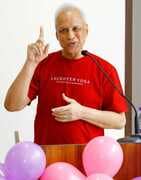
(Captain Pravin Raghuvanshi—an ex Naval Officer, possesses a multifaceted personality. He served as a Senior Advisor in prestigious Supercomputer organisation C-DAC, Pune. He was involved in various Artificial Intelligence and High-Performance Computing projects of national and international repute. He has got a long experience in the field of ‘Natural Language Processing’, especially, in the domain of Machine Translation. He has taken the mantle of translating the timeless beauties of Indian literature upon himself so that it reaches across the globe. He has also undertaken translation work for Shri Narendra Modi, the Hon’ble Prime Minister of India, which was highly appreciated by him. He is also a member of ‘Bombay Film Writer Association’.
We present Capt. Pravin Raghuvanshi ji’s amazing poem “~ Ancestral Tree…~”. We extend our heartiest thanks to the learned author Captain Pravin Raghuvanshi Ji (who is very well conversant with Hindi, Sanskrit, English and Urdu languages) and his artwork.)
~ Ancestral Tree… ~
☆
(Inspired by the poem बरगद written by Mrs. Nirdesh Nidhi ji)
O’ Woodcutter…!
At the mouth of our farm land,
Next to the puddle pond
There is this banyan tree,
That tells stories,
Narrates fables of
Our grandfathers, great grandfathers…
Many a times, there comes
this old man in my dreams,
with a humpback…
Who proclaims
This is not just a banyan tree,
It’s a family tree
People live and die
As it lives on, generation after generation…
Long back, it was crowned with
the title of *’Ageless’* by our ancestors
Since then, it wore the ‘turban of elders’…
And, as Lord Hanuman*
it has been standing rock-solid ever since,
Steadfast forever…!
Listen you, Woodcutter!
Don’t you dare touching its twigs
Leave apart even cutting its roots…
Throughout the night,
It gathers the coolness of
the nocturnal moonlight…
As it sprinkles fragrant and
soothing freshness on
the scorching bodies
of the tired travelers…
Listen, O’ Woodcutter!
What to talk of twigs,
You don’t even touch the leaves…
It plays the zither,
with a melodious sound
Singing celestial lullabies
In the Deepak Raga* tune
Adorning itself with the redness
of the dawn every morning…
Listen, O’ Woodcutter!
Leave apart even chopping the leaves
Don’t you dare
touching its winds
Which it puffs in everyone’s breath,
throughout the day…
Picks up the ‘Kalima’ –the darkness– of the night,
Authored six books on happiness: Cultivating Happiness, Nirvana – The Highest Happiness, Meditate Like the Buddha, Mission Happiness, A Flourishing Life, and The Little Book of Happiness. He served in a bank for thirty-five years and has been propagating happiness and well-being among people for the past twenty years. He is on a mission – Mission Happiness!
☆ # 07: Effortless practices for Happiness and Stress Management ☆
“There are these two kinds of happiness. Worldly happiness and spiritual happiness. Of these two kinds of happiness, spiritual happiness is foremost.”
Buddha
Spirituality means loving kindness and compassion for all sentient beings. A spiritual being harms no living being, performs wholesome deeds, and avoids unwholesome actions.
*
Spirituality brings peace of mind, balances life, and generates compassion. You become a true human being, loving, and caring for those around you. You begin looking inward and develop empathy toward all beings of nature.
There is a growing body of evidence indicating that spiritual practices are associated with better health and wellbeing. Spiritual strength can help you overcome hardships.
Spirituality provides right view and right understanding of life. It gives spiritual insight into right speech, right action, and right livelihood. Inner wisdom steers us in the right direction. If you desire everlasting health and happiness, cultivate wisdom.
Nurturing and developing your spirituality may be just as important as eating a healthy diet, exercising, and building strong relationships. Taking the time to reconnect with what you find meaningful in life and returning to life’s big questions can enhance your own sense of connection with something larger than yourself.
All the religions of the world have spirituality at their core. Spirituality means loving kindness and compassion for all sentient beings. A spiritual being harms no living being, performs wholesome deeds, and avoids unwholesome actions.
If you want others to be happy, practice compassion. If you want to be happy, practice compassion. According to Dalai Lama, “Practicing compassion, caring for others, and sharing their problems, lays the foundation for a meaningful life, not only at the level of the individual, family, or community, but also for humanity as a whole.”
Spirituality may be expressed by working for a noble and worthy cause – taking care of the environment, conservation of wildlife, rescuing child labour, educating girl child, feeding hungry ones, and healing those who are suffering from misery and illness. The aim of spirituality is taking fellow human beings from misery to happiness and creating an environment of world peace and harmony.
CULTIVATING GOODWILL
The principal focus of the teachings of Shantideva is on cultivating a mind wishing to benefit other sentient beings. With an increase in our own sense of peace and happiness, we will naturally be better able to contribute to the peace and happiness of others.
Presented in the form of a personal meditation, but offered in friendship to whoever may be interested, the following verses from Shantideva prove extremely useful and beneficial to the mind:
“All the joy the world contains,
Has come through wishing happiness for others.
All the misery the world contains,
Has come through wanting pleasure for oneself.”
“May beings everywhere who suffer,
Torment in their minds and bodies,
Have, by virtue of my merit,
Joy and happiness in boundless measure.”
“May every being ailing with disease,
Be freed at once from every malady,
May very sickness that afflicts the living,
Be wholly and forever absent from the world.”
EXERCISE
Generating goodwill for the entire cosmos
Set aside thirty minutes of time for yourself any time of the day.
Observe silence – no talking, no gestures, no written communication. All devices completely shut.
Let those around you know that you would be observing silence for the next thirty minutes and that you should not be disturbed.
Silence brings peace of mind and quietens the mind.
Take a few deep breaths and relax.
Once you have settled down, bring this thought to your mind: May all be happy, peaceful, and free.
Send good vibes for all those around you and for all those who are far away.
Generate feelings of compassion for all living beings.
May all beings – on land, water, and air – be healthy, free of any ailments, and liberated from all bondages and pain.
Feel deep from your heart and wish health, happiness, and peace for the entire universe and all beings.
May all be happy!
You will feel relaxed, stress-free, and joyful.
This is known as metta bhavana – wishing good for all. You inculcate feelings of goodness, kindness, and compassion within yourself. Gradually your behaviour begins to change. You are not rude and angry. You become gentle and kind.
BE MINDFUL
Ajahn Chah has put it beautifully, “Try to be mindful, and let things take their natural course. Then your mind will become still in any surroundings, like a clear forest pool. All kinds of wonderful, rare animals will come to drink at the pool, and you will clearly see the nature of all things. You will see many strange and wonderful things come and go, but you will be still. This is the happiness of the Buddha.”
FOUR SUBLIME STATES
The four sublime states of mind are:
-Loving kindness,
-Compassion,
-Sympathetic Joy,
-Equanimity.
These four states are sublime because they are the right attitude, the ideal way of conduct towards living beings. They provide the answer to all situations arising from social contact.
The four sublime states remove all tensions. They make peace in social conflict, and they heal wounds that are suffered in the struggle of existence. Let us strive to dwell in these sublime states.
PURIFY YOUR MIND
One must take the first step toward spirituality sometime, somewhere.
The Dhammapada is an ideal place for taking the early, tiny steps. It is one of the most widely read books on spirituality. Its concise, crystalline verses are a thing of beauty and deep meaning. It is said in the Dhammapada:
“Abstain from all unwholesome deeds,
Perform wholesome ones,
Purify your mind.
This is the teaching of the Enlightened Ones.”
What are unwholesome deeds and what are the wholesome ones? Any action that harms others, that disturbs their peace and harmony is a sinful action, an unwholesome action. Any action that helps others, that contributes to their peace and harmony, is a pious action, a wholesome action.
Here are some more verses from the Dhammapada:
“All that we are is the result of what we have thought:
It is founded on our thoughts,
It is made up of our thoughts.
“If with an impure mind
you speak or act,
then suffering follows you,
as the cartwheel follows the foot of the draft animal.
“If with a pure mind
you speak or act,
then happiness follows you,
as a shadow that never departs.
“As rain breaks through an ill-thatched house,
Passion will break through an unreflecting mind.
“As rain does not break through a well-thatched house,
Passion will not break through a well reflecting mind.
“Burning now, burning hereafter,
the wrong doer suffers doubly.
Happy now, happy hereafter,
the virtuous person doubly rejoices.
“Watching his speech,
well restrained in mind,
let a man never commit any wrong with his body!
Let a man but keep these three roads of action clear, and he will achieve the way.”
Read some more verses from the Dhammapada, or any other scriptures you like, in a relaxed environment. Read the words again and again. Read between the lines. More is left unsaid than what is expressed in words by the sages. Stop, and think deeply, and apply them one by one to your life. Spirituality is values in action. Your life begins to transform.
*
“Bhikkhus, there are these three purities. What three? Bodily purity, verbal purity, and mental purity.
” And what is bodily purity? Here, someone abstains from the destruction of life, from taking what is not given, and from sexual misconduct. This is called bodily impurity.
“And what is verbal purity? Here, someone abstains from false speech, from divisive speech, from harsh speech, and from idle chatter. This is called verbal purity.
“And what is mental purity? Here, someone is without longing, without ill will, and holds right view. This is called mental purity.
“These, bhikkhus, are the three purities.”
The Numerical Discourses of the Buddha/ Bhikkhu Bodhi
*
“Those who mistake the unessential to be essential,
A Pathway to Authentic Happiness, Well-Being & A Fulfilling Life! We teach skills to lead a healthy, happy and meaningful life.
The Science of Happiness (Positive Psychology), Meditation, Yoga, Spirituality and Laughter Yoga. We conduct talks, seminars, workshops, retreats and training.
Dr. Suresh Kumar Mishra, known for his wit and wisdom, is a prolific writer, renowned satirist, children’s literature author, and poet. He has undertaken the monumental task of writing, editing, and coordinating a total of 55 books for the Telangana government at the primary school, college, and university levels. His editorial endeavors also include online editions of works by Acharya Ramchandra Shukla.
As a celebrated satirist, Dr. Suresh Kumar Mishra has carved a niche for himself, with over eight million viewers, readers, and listeners tuning in to his literary musings on the demise of a teacher on the Sahitya AajTak channel. His contributions have earned him prestigious accolades such as the Telangana Hindi Academy’s Shreshtha Navyuva Rachnakaar Samman in 2021, presented by the honorable Chief Minister of Telangana, Mr. Chandrashekhar Rao. He has also been honored with the Vyangya Yatra Ravindranath Tyagi Stairway Award and the Sahitya Srijan Samman, alongside recognition from Prime Minister Narendra Modi and various other esteemed institutions.
Dr. Suresh Kumar Mishra’s journey is not merely one of literary accomplishments but also a testament to his unwavering dedication, creativity, and profound impact on society. His story inspires us to strive for excellence, to use our talents for the betterment of others, and to leave an indelible mark on the world.
Some precious moments of life
Honoured with ‘Shrestha Navayuvva Rachnakar Samman’ by former Chief Minister of Telangana Government, Shri K. Chandrasekhar Rao.
Honoured with Oscar, Grammy, Jnanpith, Sahitya Akademi, Dadasaheb Phalke, Padma Bhushan and many other awards by the most revered Gulzar sahab (Sampurn Singh Kalra), the lighthouse of the world of literature and cinema, during the Sahitya Suman Samman held in Mumbai.
Meeting the famous litterateur Shri Vinod Kumar Shukla Ji, honoured with Jnanpith Award.
Got the privilege of meeting Mr. Perfectionist of Bollywood, actor Aamir Khan.
Meeting the powerful actor Vicky Kaushal on the occasion of being honoured by Vishva Katha Rangmanch.
Today we present his सतिरे Chips, Clicks, and the Cry of Empty Pockets.
☆ Witful Warmth# 53 ☆
☆ Satire ☆ Chips, Clicks, and the Cry of Empty Pockets… ☆ Dr. Suresh Kumar Mishra ‘Uratript’ ☆
Now, I reckon it was a balmy Hyderabad evening, as balmy as a politician’s promise on election eve, and there I was, a poor soul, traipsing through the labyrinthine alleys of the city, searching for a chip-set for my infernal smart-contraption. Started my pilgrimage at five bells, and by eight, my spirits were as low as a snake’s belly in a ditch. This here Hyderabad, it seemed to have declared a holy war on ‘technological contentment’. The tech-parks were disgorging human beings like a leaky faucet, and the fancy gadget shops, these vegan eating-houses, and these ‘co-working’ dens were packed tighter than a sardine can on a monsoon evening. The online gaming parlors, well, they had young’uns glued to ’em like flies to a honey pot, their futures, if you can call ’em that, gambled away on glowing screens. And my chip-set? Ha! That elusive little bugger was probably holed up in some dark corner of the internet, waiting for its price to soar higher than a balloon at a carnival, much like a startup investor waiting for his golden goose to lay an egg.
I mused, in this digital purgatory, perhaps a cup of organic green tea might just cleanse my weary soul. So, I ambled into a ‘hip’ café, but lo and behold, peace was as scarce as common sense at a political rally! My inner ‘social media influencer’—a beast I usually keep chained in the basement of my conscience—awoke with a start, ready to churn out ‘reels’ faster than a politician spins lies. It brought to mind ol’ Mark Zuckerberg’s edict: “Move fast and break things.” And by Jove, this chip-set scarcity was surely breaking the back of this city’s ‘fast-growth’ gospel, wasn’t it? A chuckle, dry as a desert bone, escaped my lips. What was I, if not a digital phantom, my online identity stuck in a perpetual ‘buffering’ loop? Was I, too, one of those poor fools trying to buy ‘coding’ with ‘no-code’ tools? Likely so! This city, bless its cotton socks, had a ‘subscription plan’ for everything under the sun, except for the common decency of human compassion. I felt like a bewildered soul lost in some infernal ‘metaverse,’ where every ‘avatar’ was haggling for its worth, and I, a mere ‘user,’ had naught but the relentless ‘scroll’ of my thumb. As I stepped out, a young lad, looking as if he’d been plucked from a ‘digital detox’ clinic, extended a hand, “Master, a data pack, if you please, may your internet flourish!” I swear, if I’d had a ‘gigabyte’ to spare, I’d have given it to him to change his miserable ‘connectivity,’ but all I had was a ‘story,’ a ‘thread,’ and a ‘meme.’
Now, my ‘thinking cloud’ was racing faster than a 5G download, and that young chap’s face was playing a ‘looping GIF’ in my mind’s eye. Twenty-five, maybe thirty years old, skinny as a rail, but with a peculiar ‘no-Wi-Fi’ glint in his eyes. Was he a ‘digital pauper’ or some ‘tech-savvy’ con artist? His threadbare T-shirt and worn-out jeans were mocking the very idea of a ‘smart-casual’ dress code. I fumbled in my pocket, hunting for a ‘five-hundred MB’ pack, felt like an ‘archaeologist’ digging for ‘deleted files’ in some ancient hard drive. When I finally unearthed that paltry ’50 MB plan’ from amidst a heap of leftover data packs, it felt like unearthing ‘data from a lost civilization.’ But when I looked up, the lad was gone! ‘Invisible User’ – I declared myself the accidental inventor of a new ‘cyber-crime’ narrative. Had he truly vanished, or was my ‘data-sharing’ speed so abysmal that he figured, “Bless me, by the time you fire up that ‘hotspot,’ I’ll have begged four more ‘free Wi-Fi’ zones dry!” A ‘battery-low’ icon zipped into a nearby alley, and my brain screamed – ‘Connected!’ It was him, my ‘data-saving-campaign’ hero! “Hey, here’s your data!” I hollered, but he had ‘notification-muted’ himself so thoroughly, it was as if some ‘tech giant’ had decided to ignore user privacy altogether. He slumped onto a large charging station, his back to me, his face buried in his hands. I thought, this ‘user’ ain’t no user, he’s a ‘digital depression’ victim. Elon Musk, he once famously declared, “We are in a future where ‘Teslas’ are driving on roads, but people are still walking.” But this ‘digital’ beggar, he was hiding his ‘disconnection’ like a dirty secret, as if someone had managed to ‘monetize’ his ‘un-plugged’ existence. Was this merely ‘data-hunger,’ or a living, breathing ‘digital satire’ of this very city?
Stepping down from the cafe, I felt like I’d stumbled onto the set of a ‘web-series’ gone wrong. Right there, in the middle of the alley, a young woman, wrapped in broken headphones, a year-old child cradled in her arms, and ‘touch-screen’ tears tracing paths down her face – it was a scene so ‘pixelated’ it made my ‘4K vision’ blur for a spell. She was weeping in ’emoji’ form, as if her tears held all the ‘bugs’ of this sprawling city. I watched as her sobs subsided, and she looked at me like a ‘QR code,’ then bowed, “Sir…” Suddenly, it clicked! This was that ‘content creator’ family I’d met two years back at a workshop, when we were all trying to go ‘viral.’ “Is that your ‘follower’?” I asked, and she, with a ‘yes, sir,’ began to weave her ‘life-story.’ I reckoned, if George Orwell had witnessed this, he might’ve ripped up his next ‘dystopian’ novel and started afresh right there. She was thin as a rail, like a ‘low-battery’ warning, and her husband’s ‘network bars’ were dangling precariously, as if threatening to ‘disconnect’ at any moment. I thought, this ain’t poverty, this is a live demonstration of the ‘digital divide.’ Without needing to ask, I understood their plight. ‘Content creators’ from a ‘tier-2’ town, chasing ‘views’ like a dog chases its tail, and I remembered that first time I saw their ‘low-resolution’ predicament, and my ‘like’ button had cried out in anguish. But now, my ‘heart’ was ‘un-liked,’ a ‘hardware’ so hardened, no ‘software’ could melt it. I figured, in this country, ‘digital destitution’ wasn’t a problem, it was just a ‘trending hashtag,’ and everyone was playing their part to perfection.
“After how many ‘videos’ did this ‘viral’ child come to us? Today, he yearns for a single ‘like.'” The young woman’s words echoed in my ears like the sound of a ‘buffering’ video. I looked at the child, plump as a fresh ‘download,’ but his state was like a ‘growing subscriber’ whose ‘channel’ had suddenly been ‘deleted.’ That ‘low-battery’ little one was sucking his thumb, and it dawned on me that he wasn’t sucking his thumb, but rather, the very ‘digital ethics’ of this society. I transferred a ‘digital transaction’ into her hand, and she took it as if I’d handed her the world’s largest ‘Bitcoin.’ “If there’s any ‘remote’ job, sahib, please get us one. We’ll both ‘freelance,’ we haven’t had ‘Wi-Fi’ connected for three days.” Three days! Good heavens, these folks were dying of ‘digital deprivation’ while I was here crafting ‘memes’! Harishankar Parsai, a wise old bird, once said, “In a country where you have the freedom to curse, you don’t need the freedom to speak the truth.” And I wondered, was I, too, engaged in ‘digital hypocrisy,’ merely for the sake of my ‘keyboard’ clatter? I told her, “Online jobs ain’t easy to come by. But anyway, meet me on ‘LinkedIn’ in a week.” And I handed over my ‘profile.’ The couple looked at me with ‘thank you’ ’emojis,’ but the husband’s face carried a ‘signal-loss’ kind of anguish that words couldn’t possibly capture. His eyes screamed, “I don’t need ‘online charity,’ I need ‘real’ work!” This wasn’t satire; it was an ‘Artificial Intelligence’ ‘glitch’ that had thoroughly scrambled all my ‘algorithms.’ I reckoned, in this country, there’s no ‘virus’ bigger than the ‘digital divide,’ and no ‘software update’ more crucial than ’employment.’
Wandering through the electronics market, my mind drifted back two years, to a time when I was hunting for ‘genuine accessories’ for my new ‘iPhone.’ A ‘fast charging’ hub stood ready, and after tucking my belongings into a ‘digital locker,’ I settled into the ‘experience zone.’ The view outside? On one side, phones with ‘broken screens,’ ‘repair shops,’ and mountains of ‘e-waste’ – a scene straight out of a ‘cyber-crime’ movie, only the ‘multimedia’ colors were a bit faded. On the other side, ‘dated operating system’ gadgets, with kids playing ‘games’ like ‘professional e-sports athletes,’ begging for ‘in-app purchases’ as if their ‘lifetime subscriptions’ depended on it. ‘Users’ who shelled out money for ‘in-game items,’ those kids would ‘hack’ and extract them in a flash. Their ‘pixel-by-pixel’ tapping after money felt like a painful ‘digital entertainment’ to me. I thought, these weren’t just kids; they were ‘data miners,’ diving into the ‘virtual world’ for their ‘bread-and-butter.’ In my ‘pocket Wi-Fi’ section, a ‘tech entrepreneur’ and an ‘influencer’ boarded, looking like ‘business partners.’ They seemed to have come from ‘Cyberabad,’ seeking ‘funding’ with promises. After being ‘hacked’ during a ‘pitching session,’ they were returning to their ‘startup’ in a ‘data-corrupted’ state. Outside the ‘incubator,’ their two ‘angel investors’ stood by, and the entrepreneur offered a ‘five thousand dollar’ ‘check.’ “Only five thousand dollars given… what about the rest?” The investor’s voice was like a ‘venture capitalist’ collecting his ‘equity.’ I thought, these aren’t just investors; they’re ‘digital money launderers’!
“What rest, we agreed on five thousand dollars,” the entrepreneur said, pointing to the ‘CEO’ standing nearby. “These five thousand dollars are fine for me, give him three thousand.” The influencer, standing beside him, chimed in, “…and three thousand dollars? I won’t even give a thousand. It was settled that you’d both get a total of five thousand dollars.” I thought, this wasn’t a ‘startup pitch’; it was a bargain at a ‘black market,’ where ‘equity’ had become a subject of negotiation. Her husband pulled out a thousand dollars and offered it to the other investor. He flatly refused to take it. “If it’s one cent less than three thousand dollars, we won’t take it. They even started returning the first five thousand.” The second investor, with a ‘download-failed’ tone, sneered, “From where will such ‘budget-conscious’ startups become ‘unicorns’?” His words struck me like a ‘ransomware attack.’ The entrepreneur ‘froze,’ and his wife, the influencer, showed rapidly changing ’emojis’ of distress. Suddenly, her ‘battery’ began to ‘overflow.’ Wiping tears with a ‘power bank,’ she cried, “Smash three thousand dollars on his face!” Those two ‘mock-CEOs,’ making money from such a vile act, grinned sheepishly and walked away. The ‘file transfer’ had also started, but her ‘screen’ wouldn’t stop weeping. Her husband tried to ‘debug’ her repeatedly, but she kept crying. In a frantic ‘error-message’ voice, she cried, “Did we come all this way to hear these words from such ‘fake-profile’ people?” I thought, this woman wasn’t just a woman; she was a victim of ‘digital fraud.’ I tried to ‘recover’ her ‘corrupted data’ with a few words, but my interference wasn’t appreciated. After a while, she ‘rebooted.’ I figured, in this country, even ‘Web-3.0’ demands its ‘fees,’ and if the ‘blockchain’ falls short, they threaten with ‘NFTs.’
In Hyderabad, they were ‘tech-workers.’ Both husband and wife worked ‘remotely.’ He wrote ‘code.’ She analyzed ‘data.’ They managed their household on a ‘fixed income,’ saving quite a bit. I thought, these folks were the true face of ‘New-Age India,’ living their ‘digital’ lives independently, without any ‘government schemes.’ They had been married for eight years but were ‘childless.’ The husband was indifferent to this, but the wife couldn’t be. She had been saving money for ‘IVF’ for a year. Although the husband didn’t believe in it, he came along for his wife’s sake. I thought, this wasn’t ‘medical tourism’; it was ‘biotech hope,’ which people sought in ‘clinics.’ From ‘online consultation’ to ‘Hyderabad,’ I kept talking to them. The husband and wife shared a deeply ‘chemical bond’ of love. Both thoroughly enjoyed their ‘digital’ journey. They gave money to every ‘charity link’ that came their way. From ‘delivery’ apps to ‘subscriptions’ and ‘premium features,’ they enjoyed buying everything. I thought, these people knew how to buy ‘happiness’ ‘online,’ even if it was ‘virtual.’ When we bid farewell upon reaching Hyderabad, it felt as if ‘connections’ of many years were now ‘disconnecting.’ I thought, in this country, people ‘follow’ each other as quickly as they ‘unfollow.’ The place where they were sitting was just a ‘Wi-Fi zone’ away. Knowing that at least today they would get food with the money I had ‘UPI’ed them filled me with immense satisfaction. I thought, my ‘digital benevolence’ had come alive, if only for a short while.
Suddenly, a young woman, with ‘scattered pixels’ in her hair, came running towards me, weeping. She stood before me, glaring like a ‘bug.’ I looked back at her, her eyes brimming with ‘errors.’ It was that same ‘content creator.’ “Sir, have you seen my ‘account’? Have you seen my ‘channel’?” “Your ‘account’! The one that was ‘deleted’?” “Yes, that one… someone ‘hacked’ it.” I blurted out, “It won’t go anywhere. Don’t worry, where’s your husband? Let’s report it to the ‘cyber cell’.” Comforting her, I started walking with her towards her ‘IP address.’ It was eight o’clock at night. There was no other ‘software,’ so I bought a ‘connection’ from an ‘expensive foreign VPN’ store and came to her house through the same ‘dark web’ route. There, her husband sat in a deplorable state, his head in his ‘hard disk.’ He looked at me like a ‘Blue Screen of Death.’ “I left the ‘channel’ with them to get ‘cloud storage.’ When I returned, it was gone,” she said. After that, she didn’t stay in front of me. Pounding her ‘mouse’ and ‘keyboard,’ she cried out… “My ‘viral’ child, where have you gone… Ha…” She ran into the ‘alley’ between the ‘phishing sites,’ questioning anyone carrying a ‘recovered account.’ Her wailing and lamenting grew louder and louder. “Let’s report it to the ‘cyber cell’,” I told her husband. “I’ve ‘scanned’ everywhere. I’ve also ‘complained’ to the ‘police’.” After staying there for five minutes, I started walking towards my house. After years of ‘networking,’ a ‘follower’ had been gained. Now, where had it ‘vanished’?” When my wife came to me, holding our son in her ‘tablet,’ I remembered that ‘data-lost’ child and the ‘suffering motherboard.’ I ‘zoomed’ in on the child and kissed him. Two days passed. An ‘app developer’ was shouting from outside. I called out to the ‘app developer’ and went out. The ‘app developer’ was none other than that ‘tech-worker’ from Secunderabad. He had arranged beautiful ‘apps’ in a ‘play store’ basket. Placing the ‘play store’ on a ‘laptop-like’ platform, I began choosing ‘apps.’ His lips trembled, his eyes welled up. “Did you find the ‘account’?” I asked. “It won’t be found.” “Why won’t it be found?” “The ‘account’ wasn’t ‘hacked’; this sinner sold it for fifty ‘dollars’.” “You sold the child’s ‘account’…” He sat on the ‘laptop,’ wiping his eyes, and said, “To save the child, she was ready to go ‘offline’ and die of hunger. Whatever ‘digital content’ she got, she’d give to the child. Even after giving so much, the child’s ‘data’ wasn’t full, sir…” “Then?” “Then I couldn’t find any other ‘loophole’ for income.” “A ‘dark web king’ from outside asked for the child. He promised good ‘profiling.’ Thinking it was for everyone’s good, I sold the ‘account.’ My wife doesn’t know about this.” I sighed. “This sinner sold the child with these very ‘clicks.’ I’m doing ‘app development’ with those very dollars. Every day I earn two-four ‘dollars.’ I’ve told my wife that you gave me money for ‘funding’ the business. If she finds out about selling the child, she’ll ‘system crash’ herself.” “How could your ‘moral algorithm’ allow this…? You got this ‘account’ by seeking ‘funding’ from ‘Cyberabad’?” I asked. Hearing my words, he just kept ‘buffering’ for a long time, as if that ‘loading’ contained every ‘click’ of that child, every ‘tear’ of that mother, and every ‘error’ of that father. I thought, in this world, there’s no ‘virus’ bigger than ‘digital divide,’ and no ‘cyber attack’ bigger than ‘hunger.’ And finally, I could only say, “Oh, ‘online life,’ what a ‘business model’ you have, where a mother’s ‘like’ and a father’s ‘subscription’ are sold in the ‘dark web’!”
Authored six books on happiness:Cultivating Happiness, Nirvana – The Highest Happiness, Meditate Like the Buddha, Mission Happiness, A Flourishing Life, and The Little Book of Happiness. He served in a bank for thirty-five years and has been propagating happiness and well-being among people for the past twenty years. He is on a mission – Mission Happiness!
☆ # 06: Effortless practices for Happiness and Stress Management ☆
FLOURISH, DO NOT LANGUISH
“We can all say “yes” to more positive emotion. We can all say “yes” to more engagement. We can all say “yes” to better relationships. We can all say “yes” to more meaning in life. We can all say “yes” to more positive accomplishment. We can all say “yes” to more well-being.”
Martin Seligman
People flourish when they experience a balance of positive emotions, engagement with the world, good relationships with others, a sense of meaning and moral purpose, and the accomplishment of valued goals.
Flourishing is the experience of life going well – a combination of feeling good and functioning effectively. It is the opposite of languishing – living a life that feels hollow and empty.
If you have experienced the positive emotions of gratitude, forgiveness, contentment, mindfulness, hope, and optimism, you are closer to flourishing than a person who has just enjoyed the fleeting pleasures of life.
Flourishing is not just a simple measure of happiness or life satisfaction or positive thinking. It is a state where people experience positive emotions, positive psychological functioning, and positive social functioning, most of the time.
Positive relationships are at the core of a flourishing life. The richest source of happiness in life are other people. If we could build good relationships with them, we would be much happier.
You can be happier if you cultivate good relationships with your family, friends and even strangers whom you meet in your day-to-day life. A warm greeting, an authentic conversation and a goodbye full of loving care can work wonders.
Happy people are good at their friendships, families, and intimate relationships.
EXERCISE
What went well?
Each night before going to sleep, write down three things that went well during the day, that made you happy or things for which you are grateful.
These may be small things or important ones.
Doing this exercise regularly can help you appreciate the positive in your life rather than take it for granted.
You can do this exercise on our own or with a loved one – a partner, child, parent, sibling, or close friend.
Expressing gratitude together can contribute in a meaningful way to the relationship.
You will be less depressed and feel happier.
VIRTUES AND STRENGTHS
Almost all traditions and cultures across the globe endorse six virtues – wisdom and knowledge, courage, love and humanity, justice, temperance, and spirituality and transcendence. There are several distinct routes – the strengths of character – to each of these virtues.
Curiosity or interest in the world, love of learning, judgement, critical thinking, open-mindedness, ingenuity, originality, practical intelligence, street smarts, social intelligence, personal intelligence, emotional intelligence, and perspective are routes to the virtue cluster of wisdom and intelligence.
Valour, bravery, perseverance, industry, diligence, integrity, genuineness, and honesty are routes to the virtue of courage. The virtue of humanity and love may be reached through kindness, generosity, loving, and allowing oneself to be loved.
The strengths of justice show up in civic activities and may be exhibited by citizenship, duty, teamwork, loyalty, fairness, equity, and leadership. Temperance refers to the appropriate and moderate expression of your appetites and wants. It may be achieved by self-control, prudence, discretion, caution, humility, and modesty.
Appreciation of beauty and excellence, gratitude, hope, optimism, future-mindedness, spirituality, sense of purpose, faith, religiousness, forgiveness, mercy, playfulness, humour, zest, passion, and enthusiasm are the routes to the virtue of transcendence.
We possess these strengths of character to a lesser or more degree but some of these strengths are well pronounced and in abundance. We enjoy exhibiting these strengths and they come naturally to us. They are our signature strengthens and we must use them more and more, again and again in the mansions of life – work, love, and parenting.
AUTHENTIC HAPPINESS
To flourish, an individual must be authentically happy – experiencing positive emotions, deep engagement, and meaning in life. This means access to the pleasant life, the engaged or good life, and the meaningful life.
‘Pleasure’ and ‘gratification’ are two different words that are sometimes used interchangeably. Eating an ice-cream or getting a massage are examples of pleasure, while playing football or doing an act of kindness are examples of gratification.
Gratitude, forgiveness, savouring, mindfulness, optimism, and hope are some of the positive emotions that we can feel. A life that successfully pursues the positive emotions about the past, present, and future is the pleasant life.
If you want to be happy, you must discover your signature strengths and put them into action. Using your signature strengths to obtain abundant gratification in the main realms of life is the good life.
A meaningful life is a life of meaning. Using your signature strengths and virtues in the service of something much larger than you are is the meaningful life. To live all three lives is to lead a full life.
Positive emotion is good for happiness but engagement in meaningful work helps you flourish. Happiness is the experience of positive emotions like joy and ecstasy along with a feeling that life is meaningful and worthwhile.
Gratitude helps us build new relationships and strengthen existing ones. It dissolves anger, bitterness, and jealousy. Gratitude is a meta strategy for happiness. Cultivate an attitude of gratitude to be happier in life.
According to Edward Deiner, “Happiness doesn’t just feel good. It is good for you and for society. Happy people are more successful, have better relationships, are healthier and live longer.”
Apart from experiencing positive emotions, one must be engaged in a creative pursuit, and have a purpose in life. If you have an engaged and meaningful life, you are experiencing flourishing in life.
The individual must also have a positive outlook of life, full of hope and optimism, coupled with positive relationships and strong social support system. The person must always strive for positive accomplishments in life that become foundation stones for lasting happiness.
A person who has strived for positive accomplishments experiences authentic happiness and a greater sense of well-being.
THE MAGIC TRIANGLE
People that exhibit flourishing are engaged in social participation and people that are engaged in social participation exhibit flourishing. Along with personal achievement in their life, they also focus on civic duty and social engagement. According to Stefan Klein, “A civic sense, social equality, and control over our own lives constitute the magic triangle of well-being in society.”
To flourish, an individual must also have a good measure of self-esteem, vitality, resilience, and self-determination. We must learn to be resilient in handling day-to-day problems that are common and thinking more realistically and flexibly about the problems we encounter.
Flourishing is not something that you can find, acquire, or achieve directly. You must get the conditions right and then wait. Just as plants need sun, water, and good soil to thrive, people need love, work, and a connection to something larger.
Jonathan Haidt has expressed it succinctly, “It is worth striving to get the right relationships between yourself and others, between yourself and your work, and between yourself and something larger than yourself. If you get these relationships right, a sense of purpose and meaning will emerge. Happiness requires changing yourself and changing your world. It requires pursuing your own goals and fitting in with others.”
WHAT IS FLOURISHING?
Happiness is a thing and well-being is a construct. For example, weather is made up of elements like temperature, humidity, windspeed, barometric pressure, and the like.
Martin Seligman, known as the father of Positive Psychology, developed the PERMA model, which identifies the five things necessary for wellbeing. PERMA stands for positive emotion (P), engagement (E), relationships (R), meaning (M) and achievement (A).
If you are looking to increase the amount of happiness in your own life and on the planet, then your goal, perhaps, is authentic happiness. but, if you are looking to increase the amount of flourishing in your life and on the planet, your goal is well-being.
Please spare a while and answer the following questions honestly:
Taking all things together, how happy would you say you are?
Do you love learning new things?
Do you generally feel that what you do in your life is valuable and worthwhile?
In general, do you feel very positive about yourself?
Are you always optimistic about your future?
When things go wrong in your life, do you bounce back to normal soon?
Are there people in your life who really care about you?
Your answers to these questions are indicative of the following features of your personality:
Positive emotion
Engagement, interest
Meaning, purpose
Self-esteem
Optimism
Resilience
Positive relationships.
Based on their research in each of the twenty-three European Union nations, Felicia Huppert and Timothy So of the University of Cambridge have defined flourishing. According to them, to flourish an individual must have all the core features – positive emotions, engagement, and meaning – and three of the six additional features – self-esteem, optimism, resilience, vitality, self-determination, and positive relationships.
According to their findings, Denmark leads Europe, with 33 percent of its citizens flourishing. The United Kingdom has about half that rate, with 18 percent flourishing; Russia sits at the bottom, with only 6 percent of its citizens flourishing.
When individuals flourish, health, productivity, and peace follow. According to an estimate, 51 percent of the people of the world will be flourishing by the year 2051.
“It is all too commonplace not to be mentally ill but to be stuck and languishing in life.
“Positive mental health is a presence: the presence of positive emotion, the presence of engagement, the presence of meaning, the presence of good relationships, and the presence of accomplishment.
“Being in a state of mental health is not merely being disorder free; rather it is the presence of flourishing.”
Flourish / Martin Seligman
“By happiness I mean a deep sense of flourishing that arises from an exceptionally healthy mind. This is not a mere pleasurable feeling, a fleeting emotion, or a mood, but an optimal state of being. Happiness is also a way of interpreting the world, since it may be difficult to change the world, it is always possible to change the way we look at it.”
A Pathway to Authentic Happiness, Well-Being & A Fulfilling Life! We teach skills to lead a healthy, happy and meaningful life.
The Science of Happiness (Positive Psychology), Meditation, Yoga, Spirituality and Laughter Yoga. We conduct talks, seminars, workshops, retreats and training.
Dr. Suresh Kumar Mishra, known for his wit and wisdom, is a prolific writer, renowned satirist, children’s literature author, and poet. He has undertaken the monumental task of writing, editing, and coordinating a total of 55 books for the Telangana government at the primary school, college, and university levels. His editorial endeavors also include online editions of works by Acharya Ramchandra Shukla.
As a celebrated satirist, Dr. Suresh Kumar Mishra has carved a niche for himself, with over eight million viewers, readers, and listeners tuning in to his literary musings on the demise of a teacher on the Sahitya AajTak channel. His contributions have earned him prestigious accolades such as the Telangana Hindi Academy’s Shreshtha Navyuva Rachnakaar Samman in 2021, presented by the honorable Chief Minister of Telangana, Mr. Chandrashekhar Rao. He has also been honored with the Vyangya Yatra Ravindranath Tyagi Stairway Award and the Sahitya Srijan Samman, alongside recognition from Prime Minister Narendra Modi and various other esteemed institutions.
Dr. Suresh Kumar Mishra’s journey is not merely one of literary accomplishments but also a testament to his unwavering dedication, creativity, and profound impact on society. His story inspires us to strive for excellence, to use our talents for the betterment of others, and to leave an indelible mark on the world.
Some precious moments of life
Honoured with ‘Shrestha Navayuvva Rachnakar Samman’ by former Chief Minister of Telangana Government, Shri K. Chandrasekhar Rao.
Honoured with Oscar, Grammy, Jnanpith, Sahitya Akademi, Dadasaheb Phalke, Padma Bhushan and many other awards by the most revered Gulzar sahab (Sampurn Singh Kalra), the lighthouse of the world of literature and cinema, during the Sahitya Suman Samman held in Mumbai.
Meeting the famous litterateur Shri Vinod Kumar Shukla Ji, honoured with Jnanpith Award.
Got the privilege of meeting Mr. Perfectionist of Bollywood, actor Aamir Khan.
Meeting the powerful actor Vicky Kaushal on the occasion of being honoured by Vishva Katha Rangmanch.
Today we present his satire Leadership By Loudspeaker: Akarmpur’s Path To Parched Prosperity.
☆ Witful Warmth# 52 ☆
☆ Satire ☆ Leadership By Loudspeaker: Akarmpur’s Path To Parched Prosperity… ☆ Dr. Suresh Kumar Mishra ‘Uratript’ ☆
I still vividly recall those golden mornings in Akarmpur, a village where every problem found its solution not through diligent effort, but through a new ‘totka’ – a ritual, a gimmick, a quick fix. Akarmpur was not merely a village; it was a philosophy, a living embodiment of the maxim: ‘Do less, show more.’ Here, hard work was perpetually sidelined, relegated to the margins, while ostentation, pretense, and immediate ‘ritualistic compliance’ were elevated to the status of ‘supreme duty.’ The people of Akarmpur, as if liberated from a centuries-old curse of labor, now sought only the path of ease and comfort. If the specter of drought loomed over the village, instead of tilling the fields, a team of priests would be summoned. They would gaze intently at the sky, attempting to ‘mesmerize’ the clouds with their chants. When crops failed, there was no deliberation on the quality of seeds or the lack of irrigation; instead, easy remedies like ‘Shani’s donation’ or ‘Rahu’s wrath’ were sought.
Our village headman, Shri ‘Banaavati Lal’ – whose oratorical prowess was astounding but whose capacity for action was nil – would always declare, “Look, brothers, it’s all about ideas; action is merely a formality. When thoughts are pure, results will manifest on their own!” And the people of Akarmpur, so immersed in this cry of ‘thought revolution,’ remained oblivious to their crumbling huts, parched fields, and empty platters. Every evening, meetings were held at the Chaupal (village square) where grand theories of ‘nation-building’ were discussed. Afterwards, everyone would return to their homes, satisfied that they had offered their oblations in the ‘sacrifice of knowledge’ for the day. If someone asked, “Why is there no water?” the answer would come, “Oh, we are performing a ‘water-yagya’ for the water problem! We just need a little more ghee.” A problem was never a problem; it was merely an ‘opportunity for a ritual.’ And in the midst of these endless rituals, Akarmpur slowly, smilingly, dug its own grave. Every face was content, not because any real work had been done, but because the showmanship was so spectacular that it defied questioning! This had become the inherent nature of Akarmpur, where ‘inaction’ was the greatest ‘action.’
One day, as the sun began to scorch Akarmpur’s earth and the water in the wells receded into the netherworld, a desperate cry echoed through the village. Children whimpered from thirst, women stood helpless with empty pitchers, and men cursed the heavens. But lo and behold, our सरपंच Banaavati Lal, who saw a ‘new opportunity’ in every calamity, immediately announced an ‘unprecedented Water Crisis Aversion Grand Ritual’ (Adbhoot Jal-Sankat Nivaaran Maha-Yagya). A massive sacrificial pit was constructed in the village’s largest field. A team of twenty priests was summoned, their fees paid by the villagers who cut into their meager meals. During the ritual, white powder dissolved from a plastic container was offered instead of milk, as real milk had vanished along with the water. Fragrant oblations of ‘vegetable oil’ replaced ghee, which, while driving away flies, failed to summon any clouds. The priests chanted mantras as if reciting dialogues from a Bollywood film – loud voices, dramatic gestures, and silence as soon as ‘cut’ was called! One priest even started snoring in the middle of a mantra, but no one paid attention, for ‘devotion’ was at its peak.
The village headman proclaimed over the microphone, “Friends! This is not just a ritual; it is the ‘Grand Confluence of our Water Consciousness’! Today, we have appeased the souls of our ancestors; now water will come on its own, just like voters on election day!” And the very next day after the ritual, the pond dried up further. Yet, the village headman attributed this to the ‘immediate effect of the ritual’ – “The impurities are drying up; pure water is coming from below!” The people were hungry and thirsty, but a sense of ‘satisfaction’ was etched on their faces, for ‘something had been done.’ And when nothing works, the pretense of ‘doing something grand’ becomes the greatest solace.
The Rally of Empty Slogans: ‘Save Water, Save Nation, Print My Name in Newspaper’
When even the grand ritual failed to bring water, and the villagers, waiting for ‘holy water,’ began to wither further, the youth brigade took charge. The leader of the youth brigade, Shri ‘Hawaabaazi’ (Mr. Empty Talk), announced, “Friends! Rituals are old traditions; now is the time for ‘modern consciousness’! We will organize the ‘Save Water, Save Nation, and Get My Name Printed in the Newspaper’ rally!” A plan for the rally was drawn up. Posters were printed, featuring one or two drops of water, with the rest of the space dominated by Shri Hawaabaazi’s smiling face. Tempos were rented, blaring patriotic songs from loudspeakers, and at every intersection, slogans like ‘Water is Life!’ and ‘How will the nation survive if you die of thirst!’ were shouted. Some people in the crowd had only come for the ‘free snacks,’ and others didn’t even know what the water problem was; they were just enjoying ‘being part of the rally.’
Hawaabaazi delivered an impassioned speech, “Communalism doesn’t bring water, casteism doesn’t make water drip! We must unite for national unity, for water!” Then, two empty buckets were symbolically burned, an act termed ‘the burning of the effigy of corruption.’ People applauded heartily, because watching burning buckets was more entertaining than looking at dry wells. The rally ended. Everyone was exhausted, but with the inner satisfaction that ‘today we have done something significant!’ The next day, large pictures were splashed across newspapers, showing Hawaabaazi and his cronies with slogans, but water was still nowhere to be found. The village children were now chanting ‘national unity’ slogans, but their thirst had only intensified.
The water problem had now taken a severe turn. People were fleeing the village, and those who remained cursed their fate. Then, a renowned intellectual from the city, Professor ‘Gyanchand’ (Mr. Knowledge Moon), who had a penchant for organizing ‘seminars’ on every problem, arranged a grand seminar in the village on ‘Water Crisis: A National Discourse.’ The seminar hall was splendid, air conditioners hummed, and mineral water bottles (which the villagers could not afford) were placed on the tables. Three scholars expressed their deep concern: “The water crisis is a ‘crisis of our morality’! It is a result of ‘global climate change’! We must ‘rethink water management’!”
Professor Gyanchand delivered an hour-long, verbose speech on the ‘economic dimensions,’ ‘social implications,’ and ‘philosophical nature’ of water. Most of the audience was either sleeping or playing games on their mobile phones. At the end of the seminar, a ‘resolution’ was passed that more ‘discussions’ on ‘water conservation’ would be held in the future. The next day, large pictures of Professor Gyanchand appeared in newspapers, showing him expressing concern over ‘the nation’s plight.’ One headline read: “Scholars Hold Deep Discussions on Water Crisis in Akarmpur, Another Step Taken Towards Solution!” Outside the village, an old woman, with thirsty eyes, looked at that newspaper, under which was written – “Professor Gyanchand said at the seminar, ‘Water is a fundamental right!'” And then she collapsed, not from knowledge, but from lack of water.
After the seminar, when the water bottles were empty and the echoes of speeches faded into the air, the situation worsened. Now, the ‘Pledge of Apathy’ loomed over the village. Our सरपंच Banaavati Lal, whose unwavering faith in ‘problem-solving’ still persisted, announced yet another ‘grand strategy’: “We must form a ‘Water Solution Committee’! This committee will prepare an ‘in-depth report’ on the ‘water crisis,’ which will pave the way for the future!” And the very next day, a ‘committee’ was formed, comprising the laziest but on paper the most ‘learned’ people in the village. The chairman of this committee was a retired Babu (clerk), Shri ‘Kaagazilaal’ (Mr. Paper Man), who was an expert at counting files but had an allergy to fieldwork.
Committee meetings began. Each meeting involved rounds of tea and samosas, followed by members ‘discussing’ the ‘report.’ Kaagazilaal would ask ‘extremely serious’ questions to each member, such as “Have we correctly defined the water crisis as a ‘problem’?” or “Do we have sufficient ‘positive outlook’?” Three months later, the committee presented a ‘voluminous report’ of 300 pages, detailing the ’causes,’ ‘effects,’ and ‘potential solutions’ to the water crisis. The report contained weighty terms like ‘river interlinking projects,’ ‘rainwater harvesting,’ and ‘public participation,’ but not a single drop of water appeared on the ground. The report was filed in a government office among piles of ‘extremely important’ documents, where it gathered dust. The villagers were happy to see the report, because ‘government work’ had been completed, but their homes still held dry pitchers. One day, a child, crying from hunger and thirst, asked his mother, “Mom, can we squeeze water from this report?” Tears welled up in his mother’s eyes, but no words escaped her parched throat.
The committee’s report, the rally’s slogans, and the ritual’s ashes, all combined to transform Akarmpur into a dry desert. The problem had now become so dire that it was difficult to ignore, yet Akarmpur’s nature remained unchanged. Now, the era of ‘scientific totkas’ began. The village’s greatest ‘scientific baba,’ Dr. ‘Ajeeblal’ (Dr. Strange Red), claimed he had a ‘mantra’ to bring ‘artificial rain.’ He constructed a large ‘apparatus’ with wires and bulbs, which he kept shining day and night, claiming that ‘this will create vibrations in the sky and bring clouds!’ Children would gather around the apparatus, thinking that perhaps candies would emerge from it. The apparatus ran for a week, the electricity bill skyrocketed, but no clouds appeared.
Then, a new ‘reformist movement’ began. Some young people raised slogans for ‘dowry-free marriages’ and ‘inter-caste marriages.’ One day, two lovers, from different castes and without dowry, ran away from the city and came to Akarmpur to get married. The so-called ‘progressive’ people of the village welcomed them like ‘heroes and heroines.’ Their pictures were published in newspapers, proclaiming, ‘Akarmpur brings revolution to society!’ But a few days later, the girl’s family arrived and took them back under threat. The ‘progressive’ people quietly slipped away, knowing that true social change comes not from ‘limelight’ but from ‘grinding effort.’ The village youth were now even more disheartened. They saw that their village’s problems, which were initially small, were only growing larger due to grand events and useless speeches. Their hearts wept, but even their tears had dried up.
In this very Akarmpur, there lived an ordinary young man named ‘Karmaveer’ (Hero of Action). He found all this showmanship distasteful. When the water crisis struck the village, he did not participate in rallies, rituals, or seminars. He quietly, along with some of his fellow youths, went to the village’s oldest well. The well had been dry for decades, filled with garbage. Karmaveer and his companions picked up shovels and began to dig. People laughed at them, “Oh, you fools, the सरपंच performed a ritual, Hawaabaazi led a rally, Professor Gyanchand held a seminar, and Kaagazilaal prepared a report! What will you achieve by digging dirt? Will you change history?” Karmaveer paid no heed to their mocking words.
Day and night, he and his companions toiled, sweating profusely. Their hands were chafed, their bodies ached, but their minds held only one resolve – water. For weeks, they dug, removed earth, and broke stones. Slowly, some other villagers, who had become disillusioned with these ‘totkas,’ began to join them. They dug small pits, cleaned the silt from ponds, and built small dams to conserve rainwater. This work proceeded slowly; there was no ‘media coverage,’ no ‘awards,’ and no ‘speeches.’ It was simply ‘relentless hard work.’ And one day, as they were digging the final layer of the well, a faint gurgling sound was heard – ‘kal-kal, kal-kal.’ And then, clear, cold water gushed forth from the well. A wave of joy swept through the village. People ran to Karmaveer and his companions, embracing them. But this joy was fleeting.
Karmaveer and his companions drew water from the well, quenching the village’s thirst, but this was only the beginning. The real challenge now lay ahead: changing the village’s mindset. When Karmaveer said, “We must now cultivate the habit of saving water in every home; these useless totkas will achieve nothing,” the very people who had just honored him now began to resent him. “What are you talking about, Karmaveer? Now that water has come, why should anyone work hard? Now we will worship the ‘water deity’ again!”
Sarpanch Banaavati Lal became active once more. He organized a ‘Water Gratitude Rally’ in which he declared himself the ‘Water Man,’ and Karmaveer’s name was nowhere to be heard. Professor Gyanchand organized another seminar, its subject being ‘The Availability of Water and Its Impact on Social Psychology,’ in which he described Karmaveer’s work as ‘unscientific’ and ‘unorganized.’ Kaagazilaal prepared a ‘supplementary report,’ claiming that the water in the well was a result of ‘his original report.’ Karmaveer saw that the people who had been with him moments ago had now returned to the ‘easy path.’ He tried to explain, “Look, this is just one well; the whole village needs water, and we must cultivate the habit of saving water!” But people ignored him. They dismissed him as ‘negative-minded’ and ‘unable to tolerate happiness,’ ostracizing him. Karmaveer found himself alone. His hard work, his sacrifice, his wisdom – all seemed in vain, because the ‘easy remedies’ had so enchanted Akarmpur that they were celebrating their own ruin as a ‘festival.’
Ultimately, Akarmpur’s ‘inherent nature’ once again dominated. When Karmaveer saw that his hard work was merely considered another ‘totka,’ and people had reverted to their old habits, his heart broke. The well he had nourished with his sweat slowly began to dry up again, because people, instead of conserving water, started wasting it, confident that ‘when thirst strikes, a new totka will work.’ The village सरपंच, Hawaabaazi, Professor Gyanchand, and Kaagazilaal had all moved to a new city, where they organized another ‘national seminar’ on ‘Lessons from Akarmpur’s Water Crisis.’ They had now become ‘global experts’ on ‘water management.’
Left behind was Akarmpur – a dry, desolate, and ruined wasteland. People began to die of hunger and thirst. The children who once chanted ‘Water is Life’ were now reduced to whispers of ‘If only… if only we had listened to that Karmaveer.’ An old mother, taking her last breath with a parched throat, looked at her child’s withered face, and a sigh escaped her lips – ‘Alas, this totka! Where has it left us!’ Karmaveer, who was among the survivors, stood on the highest mound of the village, watching his beloved Akarmpur burn, now merely a ‘heap of ashes.’ He tried to shed tears, but his eyes too had dried up. He saw that even there, some people were caressing the dry ground, searching for a new ‘tantric totka’ – perhaps a mantra to ‘transform the desert into a lush green land’! It was surely better to be a human than an angel, but becoming human required so much effort that we chose the easy path of becoming angels, and perished.
(Captain Pravin Raghuvanshi—an ex Naval Officer, possesses a multifaceted personality. He served as a Senior Advisor in prestigious Supercomputer organisation C-DAC, Pune. He was involved in various Artificial Intelligence and High-Performance Computing projects of national and international repute. He has got a long experience in the field of ‘Natural Language Processing’, especially, in the domain of Machine Translation. He has taken the mantle of translating the timeless beauties of Indian literature upon himself so that it reaches across the globe. He has also undertaken translation work for Shri Narendra Modi, the Hon’ble Prime Minister of India, which was highly appreciated by him. He is also a member of ‘Bombay Film Writer Association’.
We present Capt. Pravin Raghuvanshi ji’s amazing poem “~ Writing…~”. We extend our heartiest thanks to the learned author Captain Pravin Raghuvanshi Ji (who is very well conversant with Hindi, Sanskrit, English and Urdu languages) and his artwork.)
Authored six books on happiness: Cultivating Happiness, Nirvana – The Highest Happiness, Meditate Like the Buddha, Mission Happiness, A Flourishing Life, and The Little Book of Happiness. He served in a bank for thirty-five years and has been propagating happiness and well-being among people for the past twenty years. He is on a mission – Mission Happiness!
☆ # 05: Effortless practices for Happiness and Stress Management ☆
BE A FREE SOUL
“I think, one must finally take one’s life in one’s arms.”
Arthur Miller
We are all born free. We have the potential to be winners. We have a right to be self-determining. An authentic person experiences self-reality by knowing, being, and becoming a credible, responsive person.
We all have within us a child, an adult, and a parent. This becomes apparent when we respond differently to different situations – exhibiting fear, playfulness, balance, self-control, hatred, love, and compassion.
Sometimes we are childlike – full of feelings and emotions – laughing, crying, jumping, shouting, and screaming. At times we behave like an adult – fully aware and organized – oriented to the current reality. On other occasions, we tend to be like parents – critical and prejudicial – and often nurturing too!
Every state of mind is equally important and there is a time for it. There is a time to work and a time to play, a time to laugh and a time to cry, and a time to speak and a time to be silent.
We are all born free. We have the potential to be winners. We have a right to be self-determining. An authentic person experiences self-reality by knowing, being, and becoming a credible, responsive person.
Autonomy is a human birthright. Being autonomous means being self-governing and determining one’s own destiny. A slave can never be happy. A slave can never flourish.
According to Stephen Covey, “Every human has four endowments – self-awareness, conscience, independent will and creative freedom. These give us the ultimate human freedom… These give us the power to choose, to respond, and to change.”
We must begin by taking responsibility for our own actions and feelings. We must also learn to throw off patterns that are irrelevant and inappropriate to living in the here and now.
The litmus test of a truly autonomous person lies hidden in three fundamental capacities – awareness, spontaneity, and intimacy.
AWARENESS
Awareness is knowing what is happening now. An autonomous person is aware. His body and mind are in unison in the here and now. It is not that the body is physically present somewhere and the mind is wandering elsewhere.
One must not only be fully present but also fully aware of the situation, surroundings, and feelings of self and others. The decisions taken must depend upon the facts of the situation and not on some pre-conceived notions. Prejudices from the past must not impact actions in the present.
An autonomous person looks objectively at the situation in the present, listens attentively, seeks clarifications to arrive at a deeper understanding of the situation, and arrives at a balanced decision without being influenced by opinions.
One must be in touch with one’s feelings and sensations in the body. If you are tense, your breath is shallow. You can relax by taking a few deep breaths and exhaling in a relaxed manner. That will help you clear your mind and make a better decision.
Always listen to the other person with empathy, do not interrupt, and ask questions that help you understand the person in the right perspective. Do not form opinions about the person based on what you have been told earlier. Keep your mind open, make your own observations, and arrive at your conclusions based on the facts before you.
You must be fully present there. Fully mindful. Do not let your attention wander hither and thither. Let past prejudices and opinions not influence you. Be your own witness. Decide on your own based on the merits of the case. Take full responsibility of the decision taken by you. Be honest and upright.
Sometimes our parental influences crop up to affect our decisions or the playful child contaminates our thinking. One must be vigilant and must be in the right frame of mind, always fully aware, to make the right decisions in the here and now.
SPONTANEITY
You must have the spontaneity to choose from a whole range of behaviour that the child, adult, and parent residing within you prompt you to adopt. Your decisions must not always along the pre-decided patterns that you have been accustomed to witnessing for ages.
Spontaneity denotes choosing the right actions from a wide range of possibilities. You must choose the option that you find appropriate, as per your inner voice, and accept full responsibility for the decision. Let not your inner child or parent influence you, do not be victim of confusing voices from the past. Be analytical, choose what you find appropriate, and feel relaxed.
If you arrive at free and independent decisions, without being swayed by feelings and prejudices, you will not experience stress. You will be happy. Spontaneity helps you to be autonomous and take control of your destiny.
An autonomous person is spontaneous and flexible – not rigid and impulsive. The person is free despite basic instincts or drives, free despite inherited characteristics and environmental influences. An autonomous person can be realistic and choose from the entire spectrum of behaviour appropriate to the situation.
INTIMACY
Intimacy is expressing feelings of warmth, tenderness, and closeness toward others. One must shed masks and old programming, if any, and be warm toward people. One should not be sarcastic or play games with people. One should learn to let go and develop a capacity for intimacy.
People moving toward autonomy expands their personal capacities for awareness, spontaneity, and intimacy. Once you are open and have no conflicting voices within, you are in full control. There is no tension. You feel happy.
EXERCISE
Look inward to know yourself deeper.
Spare a few moments for yourself in a quiet place.
Just ponder:
How often do you behave like a child? Do you sulk or get angry often? Do you still laugh and play like a child?
What parental influences have you inherited? Do you have too many rigidities and prejudices? Are you nurturing and kind toward people?
How often do you analyse situations impartially? Are you aware of the circumstances and feelings of others? Do you make decisions in the here and now?
Are you still carrying burdens from the past that you would like to shed off?
How stressed do you feel?
Do you feel happy, content, and peaceful?
Are you doing your best under the situations?
What changes would you like to make in your life?
Where do you see yourself five years from now, ten years from now?
Take your own time. No hurry.
Get back to the questions that you feel are important and give a second thought.
Keep exploring. Try to be better and better every day.
You will feel liberated and on control of your destiny.
THE PARABLE OF THE EAGLE
Have you heard of the parable of the eagle? The parable is paraphrased beautifully in ‘Born to win’:
“Once upon a time, while walking through the forest, a certain man found a young eagle. He took it home and put it in his barnyard where it soon learned to eat chicken feed and to behave as chickens behave.
“One day, a naturalist who was passing by inquired of the owner why it was that an eagle, the king of all birds, should be confined to live in the barnyard with the chickens.
“Since I have given it chicken feed and trained it to be a chicken, it has never learned to fly,” replied the owner. “It behaves as chickens behave, so it is no longer an eagle.”
“Still,” insisted the naturalist, “it has the heart of an eagle and can surely be taught to fly.”
“After talking it over, the two men agreed to find out whether this was possible. Gently the naturalist took the eagle in his arms and said, “You belong to the sky, and not to the earth. Stretch forth your wings and fly.”
“The eagle, however, was confused; he did not know who he was, and, seeing the chickens eating their food, he jumped down to be with them again.
“Undismayed, the naturalist took the eagle on the following day, up on the roof of the house, and urged him again, saying, “You are an eagle. Stretch forth your wings and fly.” But the eagle was afraid of his unknown self and world and jumped down once more for the chicken food.
“On the third day the naturalist rose early and took the eagle out of the barnyard to a high mountain. There, he held the king of birds high above him and encouraged again, saying, ”You are an eagle. You belong to the sky as well as to the earth. Stretch forth your wings now, and fly.”
“The eagle looked around, back towards the barnyard and up to the sky. Still, he did not fly. Then the naturalist lifted him straight towards the sun and it happened that the eagle began to tremble, slowly he stretched his wings. At last, with a triumphant cry, he soared into the heavens.
“It may be that the eagle still remembers the chickens with nostalgia; it may be that he occasionally revisits the barnyard. But as far as anyone knows, he has never returned to lead the life of a chicken, He was an eagle though he had been kept and tamed as a chicken.”
Be a winner. Go, kiss the world!
“It takes courage to be a real winner – not a winner in the sense of beating out someone else by always insisting on coming out on top – but a winner at responding to life. It takes courage to experience the freedom that comes with autonomy, courage to accept intimacy and directly encounter other persons, courage to take a stand in an unpopular cause, courage to choose authenticity over approval and to choose it again and again, courage to accept the responsibility for your own choices, and, indeed, courage to be the very unique person you really are.”
A Pathway to Authentic Happiness, Well-Being & A Fulfilling Life! We teach skills to lead a healthy, happy and meaningful life.
The Science of Happiness (Positive Psychology), Meditation, Yoga, Spirituality and Laughter Yoga. We conduct talks, seminars, workshops, retreats and training.
Dr. Suresh Kumar Mishra, known for his wit and wisdom, is a prolific writer, renowned satirist, children’s literature author, and poet. He has undertaken the monumental task of writing, editing, and coordinating a total of 55 books for the Telangana government at the primary school, college, and university levels. His editorial endeavors also include online editions of works by Acharya Ramchandra Shukla.
As a celebrated satirist, Dr. Suresh Kumar Mishra has carved a niche for himself, with over eight million viewers, readers, and listeners tuning in to his literary musings on the demise of a teacher on the Sahitya AajTak channel. His contributions have earned him prestigious accolades such as the Telangana Hindi Academy’s Shreshtha Navyuva Rachnakaar Samman in 2021, presented by the honorable Chief Minister of Telangana, Mr. Chandrashekhar Rao. He has also been honored with the Vyangya Yatra Ravindranath Tyagi Stairway Award and the Sahitya Srijan Samman, alongside recognition from Prime Minister Narendra Modi and various other esteemed institutions.
Dr. Suresh Kumar Mishra’s journey is not merely one of literary accomplishments but also a testament to his unwavering dedication, creativity, and profound impact on society. His story inspires us to strive for excellence, to use our talents for the betterment of others, and to leave an indelible mark on the world.
Some precious moments of life
Honoured with ‘Shrestha Navayuvva Rachnakar Samman’ by former Chief Minister of Telangana Government, Shri K. Chandrasekhar Rao.
Honoured with Oscar, Grammy, Jnanpith, Sahitya Akademi, Dadasaheb Phalke, Padma Bhushan and many other awards by the most revered Gulzar sahab (Sampurn Singh Kalra), the lighthouse of the world of literature and cinema, during the Sahitya Suman Samman held in Mumbai.
Meeting the famous litterateur Shri Vinod Kumar Shukla Ji, honoured with Jnanpith Award.
Got the privilege of meeting Mr. Perfectionist of Bollywood, actor Aamir Khan.
Meeting the powerful actor Vicky Kaushal on the occasion of being honoured by Vishva Katha Rangmanch.
Today we present his satire Where Trees Were Promised and Titles Were Planted.
☆ Witful Warmth# 51 ☆
☆ Satire ☆ Where Trees Were Promised and Titles Were Planted… ☆ Dr. Suresh Kumar Mishra ‘Uratript’ ☆
In the dust-choked lanes of a forgotten village in Champaran, where only electoral drizzle now refreshes the thirst of hope, once sprouted a noble seedling: the Janhit Utthan Parishad. This was not an institution born of lobbying or LinkedIn connections, but of a frail old teacher—Masterji—who traded his only piece of ancestral land, not for stock options, but for the betterment of the village. Back when devotion had not yet been gobbled up by dopamine-fueled selfies, and when sacrifice did not need hashtags to go viral, Masterji dared to dream of a platform that would channel rivers of altruism. That sacred shrine of public service has now been annexed by a mob of sweet-toothed contractors who flock not to serve but to be served. The walls that once echoed with his maxim, “An institution is a temple of service,” now display laughing faces on election posters. Mahatma Gandhi still hangs there, though rumor has it he occasionally mutters, “Hey Ram! What calamity is this?”
Where once sat councils of virtue—discussing education, sanitation, and green revolutions—the institution’s meetings have been demoted to exhibitions of egos and necktie knots. One fine day, as though an old transistor caught a rogue frequency, ten members stood up simultaneously and cried, “The institution is sinking!” One might have mistaken it for the Titanic’s final scene, had it not been accompanied by the chairman’s candy-store smile. And like a comic twist in a political reality show, the solution proposed was not reform in intent or action, but reform in titles—new president, new vice president, and a minister to complete the trilogy. As if governance was a talent hunt and the prize was a gilded armchair. Not a whisper on principles, but a stampede for positions. Somewhere in the cracked plaster behind Masterji’s garlanded photo, his spirit may well have headbutted the wall.
Gone are the days when meeting agendas brimmed with purpose—children’s education, cleaning of the village pond, and planting of trees. The modern meeting resembles a wedding procession, without the bride. Chairs line up like anxious guests; speeches rain down like confetti, but the issues are conspicuously absent. The only mission now is the mission to capture a better camera angle. The guiding philosophy has been replaced with an inventory of chairs. One veteran, his eyes moist with betrayed faith, whispered, “We used to plant trees; now we plant titles.” This from a man who once pledged his pension to the cause, now left to admire the president’s gold chain while peering into an empty treasury register.
The annual celebration—once a festival of soil and saplings—has transformed into a carnival of banners, drums, and declarations. “Fifty trees planted this year!” the president announced, and the crowd clapped like metronomes. Meanwhile, the village searched for a single sprout. Neither pit nor plant could be found. The trees had evidently taken root in reports, watered and nourished by budget files. A trophy followed—“Best Environmentalist”—handed to the chairman, who stepped up and declared, “Our institution is the mother of society!” A child in the crowd innocently quipped, “Then why does she feel so stepmotherly?” Ah! There lies the whole tale—this mother no longer nurtures, she merely poses.
The institution’s social media handles now read like a satire on benevolence. The same leader, the same cap, the same posture—ad infinitum. Old-age homes became backdrops for photo ops. Fruits were ‘distributed’—or rather, made to hover before the lens—while the elders received smiles more than sustenance. One old man chuckled, “Son, they didn’t give us fruit; they just clicked pictures and vanished.” And thus, the institution transitioned from a service mission to a lighting studio, where emotion was the wallpaper and the spotlight reserved for faces, not causes.
As the curtain drew further, original members were either retired with ceremonial garlands or systematically muted like unwanted tabs on a browser. Masterji, once a living manual of integrity, now only grins from his dusty frame. His grandson once asked, “Grandpa, what does your institution do now?” He sighed and replied, “It’s no longer an institution, son. It’s a flea market for chairs.” The PR firm has taken over the spirit, and truth, it seems, has taken a long vacation. Masterji no longer speaks from the dais; he speaks from the frame. A relic of a time when service was the language of the soul.
Eventually, under the theatrical name of ‘restructuring,’ the institution quietly dissolved itself. No drums, no slogans, just a withered meeting where Masterji’s photo received its final garland. A crack ran down the wall, and those nearby claim they heard a voice whisper, “I created this for service. You used it for selfies.” The institution that once irrigated the barren fields of Champaran with hope has itself turned barren. Now, its tale is preserved in one corner of a modest library, in a frail diary’s final line: “There’s only one letter’s difference between service and power—but the intent is separated by a thousand miles.”
(Captain Pravin Raghuvanshi—an ex Naval Officer, possesses a multifaceted personality. He served as a Senior Advisor in prestigious Supercomputer organisation C-DAC, Pune. He was involved in various Artificial Intelligence and High-Performance Computing projects of national and international repute. He has got a long experience in the field of ‘Natural Language Processing’, especially, in the domain of Machine Translation. He has taken the mantle of translating the timeless beauties of Indian literature upon himself so that it reaches across the globe. He has also undertaken translation work for Shri Narendra Modi, the Hon’ble Prime Minister of India, which was highly appreciated by him. He is also a member of ‘Bombay Film Writer Association’.
We present Capt. Pravin Raghuvanshi ji’s amazing poem “~ Sacrificed Dreams…~”. We extend our heartiest thanks to the learned author Captain Pravin Raghuvanshi Ji (who is very well conversant with Hindi, Sanskrit, English and Urdu languages) and his artwork.)
Authored six books on happiness: Cultivating Happiness, Nirvana – The Highest Happiness, Meditate Like the Buddha, Mission Happiness, A Flourishing Life, and The Little Book of Happiness. He served in a bank for thirty-five years and has been propagating happiness and well-being among people for the past twenty years. He is on a mission – Mission Happiness!
☆ # 04: Effortless practices for Happiness and Stress Management ☆
KEEP EVOLVING, KEEP LEARNING
A musician must make music, an artist must paint, a poet must write, if he is to be ultimately happy. What a man can be, he must be. This need we may call self-actualization.
-Abraham Maslow
The happiest persons on this planet are engaged deeply in creative pursuits. They are constantly in a state of flow. They keep on creating, exploring, and evolving.
Happiness lies in activity. It is like a flowing river, not a stagnant pool. Keep moving. Keep exploring. Learning is fun. Be a lifelong learner. Grow. Evolve. One who learns continuously, one who evolves continuously, one who is never stagnant, always remains cheerful, happy, and forward looking. There is no anxiety, depression, or stress.
Action may not always bring happiness but there is no happiness without action. Happiness is not something ready-made. It comes from your own actions. You must do the work to achieve it.
The happiest persons on this planet are engaged deeply in creative pursuits. They are constantly in a state of flow. Time stands still for them. They never face boredom. One level of creativity leads to the next level. They keep on creating, exploring, and evolving. They exist at a different plane altogether.
Flow is total absorption in an activity – you lose sense of time and self. When you are in flow – deep into music, play, work, reading, or smiling with your child – oblivious of time and self, you are in heaven.
CREATE YOUR OWN HAPPINESS
What are you good at? What do you love doing? What is it that gives you contentment? Keep a palm on your heart and choose that activity honestly. Do not choose what others are doing or what you think will make you famous. Choose the activity that you are good at and find genuinely absorbing.
Try to find ways and means to do the activity as often as possible. Go deep into it and learn all the finer points. Develop your skills in the field, be a learner of the deepest level, and master all the skills needed to be the best in the field. Do not compare or compete with anyone else, compete with yourself, and be your best self.
Challenges will come. Overcome those challenges by hard work and matching your skills to meet the challenge. Stretching yourself more and more will take you to newer heights. You will be fully immersed in what you do. You will learn new skills every day. You will grow every day. You will evolve on an ongoing basis. There is no happiness like this.
Keep evolving, keep learning something new all the time. Think differently and be connected to creativity. Read a book, listen to music, paint, watch a movie, write poetry, pen a short story, record a video with a good message – anything meaningful and beautiful enough to engage you with intensity.
Create or immerse yourself in the creation of another mind. You may start with immersing yourself in the creativity of others and gradually learn to be creative in your own way. Do not be in a hurry. People often make the mistake of taking a jump before they are fully ready. Learning an art or a science takes a long time and requires patience and hard work.
You can create your own happiness by voluntarily engaging in activities like helping someone, being kind, expressing gratitude, nurturing social relationships, increasing flow experiences, practicing yoga and meditation, exercising regularly, and savouring life’s little pleasures. Choose the activities that you like and practice them regularly.
OPTIMAL EXPERIENCE
One must carefully understand each word of what Mihaly Csikszentmihalyi says about engagement and happiness, “Happiness is not something that happens. It is not the result of good fortune or random chance. It is not something that money can buy or power command. It does not depend on outside events, but rather on how we interpret them.
“Happiness, in fact, is a condition that must be prepared for, cultivated, and defended privately by each person. People who learn to control inner experience will be able to determine the quality of their lives, which is as close as any one of us can come to being happy.
“The best moments in our lives are not passive, receptive, relaxing times. The best moments usually occur when a person’s body or mind is stretched to its limits in a voluntary effort to accomplish something difficult and worthwhile. Optimal experience is thus something that we make happen.”
Flow is the psychology of optimal experience. The optimal state of inner experience is one in which there is order in consciousness. During flow, people experience deep enjoyment, creativity, and a total involvement with life.
Mihaly Csikszentmihalyi says, “By stretching skills, by reaching toward higher challenges, a person, who has achieved control over psychic energy and has invested it in carefully chosen goals, becomes an increasingly extraordinary individual.”
PLATEAU EXPERIENCE
Abraham Maslow coined and defined the term “plateau experience” as a sort of continuing peak experience that is more voluntary and one that requires a lifetime of long and arduous effort.
Maslow describes the experience, “Such people who appear to be in harmony with their lives often have moments of an extraordinary occurrence called ‘peak experiences’. These are profound moments of intense rapture and well-being, along with possibly the awareness of ultimate truth and the unity of all things. Accompanying them is a heightened sense of control over the body and emotions and a wider sense of awareness.”
According to Ed Diener, “Psychological wealth includes life satisfaction, the feeling that life is full of meaning, a sense of engagement in interesting activities, the pursuit of important goals, the experience of positive emotional feelings, and a sense of spirituality that connects people to things larger than themselves.”
EXERCISE
Making the right decisions.
Imagine you have a collection of six hats of different colours – white, red, black, yellow, green, and blue. These are your tools for arriving at the right decisions in complex life situations.
Think of a problem that you have been facing. The problem is confusing and perplexing. You are finding it difficult to arrive at a solution.
Let us begin solving it in a creative and systematic way.
Begin with wearing the white hat.
The white hat denotes purity. You look only at the pure data. Just information and facts of the case. No opinion, views, or prejudices.
You may write down the problem and all related data on a sheet of paper, or prepare a document on your computer.
Make sure it is pure data, no opinions, or pre-conceived notions.
Take off the white hat and put on the red hat.
The red hat denotes emotions. Only emotions. What you feel. No logic, pure emotions.
Express and go through all the emotions. Your fears, anxieties, and hopes about the case. Whatever you feel. Let the whole range of feelings – positive, neutral, and negative – flow. No justifications needed.
Be as irrational and emotional as you can.
Take off the red hat and put on the black hat.
The black hat is the devil’s advocate. Everything that is wrong and that may go wrong in the case. All the failures, drawbacks, and negatives about the case. The emotional as well as the logical dark side.
Imagine all that can go wrong and the havoc that may be created.
Now, take off the black hat and put the yellow hat.
Yellow is the colour of sunshine, positivity, and optimism. Look at the brighter side of the problem and list all that is good and full of hope about it.
Look at all the positives and be full of optimism and hope.
Take off the yellow hat and put on the green hat.
Green is the colour of creativity and nature. Be creative. Look at the problem from totally different perspectives. Be creative. Think laterally. Think something new, innovate, and out of the box.
Imagine what no one has ever thought about the problem. Be disruptive in your thinking, not just incremental. Find totally new solutions. Brainstorm to the fullest. Use your whole range of thinking – make use of the entire rainbow.
Now, put down the green hat and put on the blue hat.
Blue is the colour of the sky. It covers everything.
Consider whatever you have thought and felt wearing all the hats – white, red, black, yellow, and green – and summarize them. You must arrive at a balanced decision, taking everything into consideration. You must weigh all the pros and cons.
Make the ultimate decision. Let there be no doubt in mind. All apprehensions must be given consideration and cleared. Take very single factor into account and arrive at the most comprehensive decision.
Your decision should not be lopsided or taken without considering any angle. Let it be all encompassing.
You arrive at the right decision and there is no stress.
This method of arriving at a balanced decision in complex situation has been devised by Edward de Bono and is known as the Six Thinking Hats.
Not being able to reach at the right decisions causes stress and anxiety. Knowing how to make the right decisions relieves you of stress. If you have a thinking mind, if you are creative, if you are positive, if you believe in activity, and if you are not afraid to take the right decisions, you will always be happy and stress-free.
“Thinking is the ultimate human resource. Yet we can never be satisfied with our most important skill. No matter how good we become, we should always want to be better. The main difficulty in thinking is confusion. We try to do too much at once. Emotions, information, logic, hope, and creativity all crowd in on us. It is like juggling with too many balls. The six thinking hats allow us to conduct our thinking as a conductor might lead an orchestra. We can call forth what we will.”
Six Thinking Hats/ Edward de Bono
“A good life is one that is characterized by complete absorption in what one does.”
A Pathway to Authentic Happiness, Well-Being & A Fulfilling Life! We teach skills to lead a healthy, happy and meaningful life.
The Science of Happiness (Positive Psychology), Meditation, Yoga, Spirituality and Laughter Yoga. We conduct talks, seminars, workshops, retreats and training.
 ~ Ancestral Tree… ~